
F5 BIG-IP LTM has been the undisputed benchmark for enterprise load balancing for over two decades. Purpose-built from the ground up as a full Application Delivery Controller, it remains the first choice for tier-1 financial institutions, government agencies, and global telcos where failure is simply not an option.
Deployment: Dedicated hardware appliances (iSeries and rSeries), software virtual edition (VE) on VMware/KVM/Hyper-V/cloud, and managed cloud service (F5 Distributed Cloud). Hardware appliances include FPGA-accelerated SSL processing at line rate.
| Attribute | Detail |
|---|---|
| OSI Layers | L4 (TCP/UDP) through L7 (HTTP, DNS, SIP, FIX) |
| Max Throughput | Up to 400 Gbps (rSeries r10000 hardware) |
| SSL TPS | Up to 10 million TLS handshakes/sec (hardware) |
| High Availability | Active/Standby, Active/Active, N+1 clustering |
| IPv6 | Full dual-stack, IPv6-only VIPs supported |
| TLS 1.3 | Full support including 0-RTT |
| Licensing | Commercial (perpetual + subscription) |
✅ L4–L7 load balancing
✅ GSLB
✅ Hardware SSL/TLS offload
✅ iRules TCL scripting
✅ IPv6
✅ VRRP/HA
✅ HTTP/2 & WebSocket
✅ Integrated WAF
✅ REST API
AWS ELB is the world's largest managed load balancing deployment by sheer volume of traffic. Three purpose-built products: Application Load Balancer (ALB) at L7, Network Load Balancer (NLB) at L4, and Gateway Load Balancer (GWLB) for third-party appliance traffic. Fully managed, auto-scaling, zero provisioning overhead.
| Attribute | Detail |
|---|---|
| OSI Layers | L4 (NLB), L7 (ALB), L3/L4 insertion (GWLB) |
| Throughput | Effectively unlimited (AWS-managed auto-scaling) |
| High Availability | Multi-AZ by design; no manual HA config required |
| IPv6 | Dual-stack on ALB and NLB |
| TLS 1.3 | Supported on ALB and NLB |
✅ L4 + L7
✅ Auto-scaling
✅ IPv6
✅ TLS 1.3
✅ WAF integration
✅ WebSocket & HTTP/2
✅ Zero-ops
❌ No on-premises
❌ No native GSLB
Architecturally unique among cloud LB platforms: operates via a global anycast IP served from 100+ points of presence simultaneously — no regional LB instances required. Traffic is routed to the nearest healthy backend by Google's global SDN fabric (Andromeda). Unmatched for multi-region failover without DNS TTL penalties.
| Attribute | Detail |
|---|---|
| OSI Layers | L4 (TCP/UDP), L7 (HTTP/HTTPS), L3 (internal) |
| Global Reach | 100+ PoPs via anycast — unique among cloud LBs |
| IPv6 | Full IPv6 termination at edge |
| TLS 1.3 | Supported with QUIC (HTTP/3) |
✅ Global anycast single VIP
✅ L4 + L7
✅ IPv6
✅ TLS 1.3 + QUIC
✅ Cloud Armor WAF
✅ Multi-region failover
❌ GCP-only
Two complementary purpose-built load balancers: Azure Load Balancer at L4 (TCP/UDP) and Azure Application Gateway at L7 (HTTP/HTTPS). Most enterprise deployments use both in tandem. Azure Front Door extends this with global L7 LB and CDN capabilities at the edge.
| Attribute | Detail |
|---|---|
| OSI Layers | L4 (Azure LB), L7 (App Gateway), L7 global (Front Door) |
| High Availability | Zone-redundant; active-active across AZs |
| IPv6 | Dual-stack on both products |
| TLS 1.3 | Supported on App Gateway v2 |
✅ L4 + L7
✅ Zone-redundant HA
✅ IPv6
✅ TLS 1.3
✅ WAF (OWASP CRS)
✅ WebSocket
✅ Azure AD/Entra integration
❌ No on-premises LB
F5 BIG-IP LTM has been the undisputed benchmark for enterprise load balancing for over two decades. Purpose-built from the ground up as a full Application Delivery Controller, it remains the first choice for tier-1 financial institutions, government agencies, and global telcos where failure is simply not an option.
Deployment: Dedicated hardware appliances (iSeries and rSeries), software virtual edition (VE) on VMware/KVM/Hyper-V/cloud, and managed cloud service (F5 Distributed Cloud). Hardware appliances include FPGA-accelerated SSL processing at line rate.
| Attribute | Detail |
|---|---|
| OSI Layers | L4 (TCP/UDP) through L7 (HTTP, DNS, SIP, FIX) |
| Max Throughput | Up to 400 Gbps (rSeries r10000 hardware) |
| SSL TPS | Up to 10 million TLS handshakes/sec (hardware) |
| High Availability | Active/Standby, Active/Active, N+1 clustering |
| IPv6 | Full dual-stack, IPv6-only VIPs supported |
| TLS 1.3 | Full support including 0-RTT |
| Licensing | Commercial (perpetual + subscription) |
✅ L4–L7 load balancing
✅ GSLB
✅ Hardware SSL/TLS offload
✅ iRules TCL scripting
✅ IPv6
✅ VRRP/HA
✅ HTTP/2 & WebSocket
✅ Integrated WAF
✅ REST API
AWS ELB is the world's largest managed load balancing deployment by sheer volume of traffic. Three purpose-built products: Application Load Balancer (ALB) at L7, Network Load Balancer (NLB) at L4, and Gateway Load Balancer (GWLB) for third-party appliance traffic. Fully managed, auto-scaling, zero provisioning overhead.
| Attribute | Detail |
|---|---|
| OSI Layers | L4 (NLB), L7 (ALB), L3/L4 insertion (GWLB) |
| Throughput | Effectively unlimited (AWS-managed auto-scaling) |
| High Availability | Multi-AZ by design; no manual HA config required |
| IPv6 | Dual-stack on ALB and NLB |
| TLS 1.3 | Supported on ALB and NLB |
✅ L4 + L7
✅ Auto-scaling
✅ IPv6
✅ TLS 1.3
✅ WAF integration
✅ WebSocket & HTTP/2
✅ Zero-ops
❌ No on-premises
❌ No native GSLB
Architecturally unique among cloud LB platforms: operates via a global anycast IP served from 100+ points of presence simultaneously — no regional LB instances required. Traffic is routed to the nearest healthy backend by Google's global SDN fabric (Andromeda). Unmatched for multi-region failover without DNS TTL penalties.
| Attribute | Detail |
|---|---|
| OSI Layers | L4 (TCP/UDP), L7 (HTTP/HTTPS), L3 (internal) |
| Global Reach | 100+ PoPs via anycast — unique among cloud LBs |
| IPv6 | Full IPv6 termination at edge |
| TLS 1.3 | Supported with QUIC (HTTP/3) |
✅ Global anycast single VIP
✅ L4 + L7
✅ IPv6
✅ TLS 1.3 + QUIC
✅ Cloud Armor WAF
✅ Multi-region failover
❌ GCP-only
Two complementary purpose-built load balancers: Azure Load Balancer at L4 (TCP/UDP) and Azure Application Gateway at L7 (HTTP/HTTPS). Most enterprise deployments use both in tandem. Azure Front Door extends this with global L7 LB and CDN capabilities at the edge.
| Attribute | Detail |
|---|---|
| OSI Layers | L4 (Azure LB), L7 (App Gateway), L7 global (Front Door) |
| High Availability | Zone-redundant; active-active across AZs |
| IPv6 | Dual-stack on both products |
| TLS 1.3 | Supported on App Gateway v2 |
✅ L4 + L7
✅ Zone-redundant HA
✅ IPv6
✅ TLS 1.3
✅ WAF (OWASP CRS)
✅ WebSocket
✅ Azure AD/Entra integration
❌ No on-premises LB
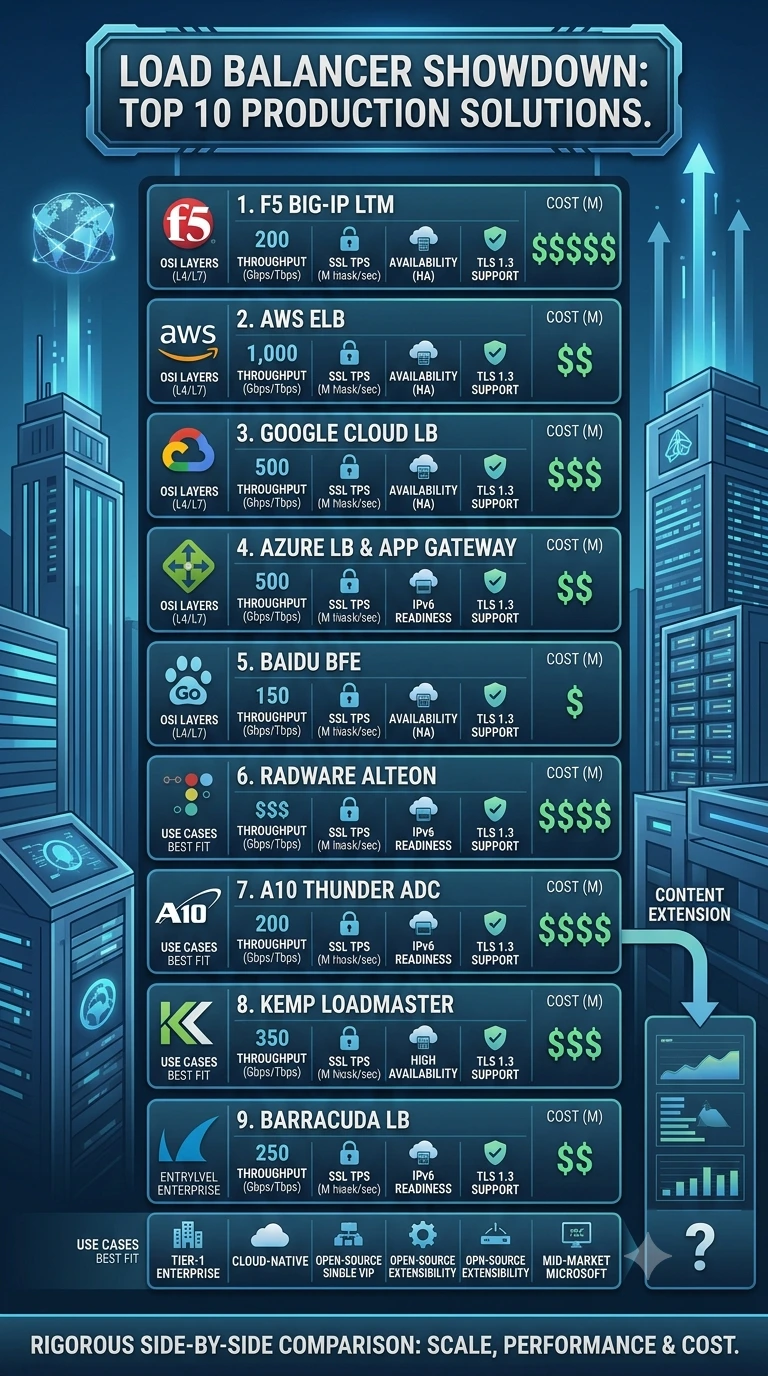
BFE is one of the most significant open-source load balancers in production today. Originally developed internally at Baidu to route their entire external web traffic — tens of millions of requests per second at peak — it was open-sourced in 2019 under the Apache 2.0 license and accepted into the CNCF sandbox in 2020. Written in Go, it is designed for horizontal scale-out, pluggable architecture, and deep protocol awareness.
| Attribute | Detail |
|---|---|
| OSI Layers | L7 (HTTP, HTTPS, HTTP/2, WebSocket, SPDY) |
| Language | Go — high concurrency, low memory footprint |
| Proven Scale | Baidu production: tens of millions RPS at peak |
| High Availability | VRRP + VIP-based active/standby; horizontal scale-out |
| Licensing | Open-Source (Apache 2.0) |
| Management | BFE-Dashboard NG (Node.js — monitoring, VRRP, VIP, IPv6) |
| IPv6 | Full dual-stack; IPv6 management via Dashboard NG |
| TLS 1.3 | Full support |
| CNCF Status | Sandbox Project (accepted 2020) |
| Deployment | Bare metal, VM, Docker, Kubernetes |
✅ L7 HTTP/HTTPS/HTTP2
✅ WebSocket & SPDY
✅ Pluggable Go module architecture
✅ Advanced traffic routing
✅ Rate limiting & circuit breaking
✅ TLS 1.3
✅ Full IPv6
✅ VRRP + VIP
✅ Real-time monitoring
✅ Open Source Apache 2.0
The upcoming BFE 1.8.2 release introduces BFE-Dashboard NG — a fully redesigned Node.js web management interface bringing enterprise-class operability to BFE deployments. New capabilities include real-time traffic monitoring, full VRRP management, VIP configuration UI, IPv6 address management, and end-to-end TLS 1.3 support throughout the management plane. BFE-Dashboard NG closes the operational gap between BFE and commercial load balancer management suites — making BFE a genuinely complete enterprise-grade open-source load balancer.
A dedicated, purpose-built application delivery and load balancing platform with a long production history in telecommunications, financial services, and large enterprise. Competes directly with F5 BIG-IP and has been a preferred alternative in EMEA and APAC markets for over two decades. Distinguished by application-aware load balancing, strong GSLB, and tight integration with Radware's DDoS protection portfolio.
| Attribute | Detail |
|---|---|
| OSI Layers | L4 through L7 (HTTP, DNS, SIP, FTP-aware) |
| Max Throughput | Up to 200 Gbps (Alteon 6000 series hardware) |
| High Availability | Active/Active and Active/Standby; VRRP-based failover |
| IPv6 | Full dual-stack |
| TLS 1.3 | Supported |
✅ L4–L7
✅ GSLB
✅ SSL/TLS offload
✅ IPv6
✅ Active/Active HA
✅ AppShape++ scripting
✅ DDoS integration
✅ HTTP/2 & WebSocket
✅ Session persistence
Purpose-built ADC and load balancer competing directly with F5 BIG-IP, often positioned as a higher-throughput, lower-cost alternative. Widely deployed in service providers, large enterprises, and carrier-grade environments requiring massive SSL throughput. Custom ASIC acceleration on hardware models delivers exceptional SSL TPS numbers.
| Attribute | Detail |
|---|---|
| OSI Layers | L4 through L7 |
| Max Throughput | Up to 1.2 Tbps (Thunder 14045 hardware) |
| SSL TPS | Up to 3 million TLS handshakes/sec |
| IPv6 | Full dual-stack |
| TLS 1.3 | Supported |
✅ L4–L7
✅ GSLB
✅ High-performance SSL offload
✅ IPv6
✅ aFleX scripting
✅ HTTP/2 & QUIC
✅ Active/Active HA
✅ Link Load Balancing
✅ DDoS protection
Purpose-built load balancer with strong presence in mid-market enterprise. Excellent price-to-capability ratio with historically dominant positioning in Microsoft-heavy environments due to certified integrations with Exchange, SharePoint, Teams, and Remote Desktop Services. A free virtual edition exists for lab and small-scale deployments.
| Attribute | Detail |
|---|---|
| OSI Layers | L4 and L7 |
| Max Throughput | Up to 40 Gbps (hardware); scalable via clustering |
| High Availability | Active/Passive (VRRP); Active/Active clustering available |
| IPv6 | Full dual-stack |
| TLS 1.3 | Supported |
✅ L4 + L7
✅ SSL/TLS offload
✅ IPv6
✅ VRRP HA
✅ Microsoft workload certified templates
✅ WAF (add-on)
✅ Content switching
~ GSLB (less mature)
Purpose-built load balancer with an integrated Web Application Firewall (WAF), distinguishing it from pure-play LB platforms. Popular in regulated industries — particularly education, healthcare, and financial services — where compliance-driven WAF capabilities are required alongside load balancing in a single appliance.
| Attribute | Detail |
|---|---|
| OSI Layers | L4 and L7 |
| Max Throughput | Up to 10 Gbps (hardware models) |
| High Availability | Active/Passive; VRRP-based |
| IPv6 | Full dual-stack |
| TLS 1.3 | Supported |
✅ L4 + L7
✅ Integrated WAF (OWASP/PCI DSS)
✅ SSL/TLS offload
✅ IPv6
✅ VRRP HA
✅ DDoS protection (basic)
✅ Session persistence
~ Limited GSLB
Purpose-built ADC and load balancer designed for tight integration within the Fortinet Security Fabric ecosystem. Most compelling for organizations already standardized on FortiGate firewalls, FortiSIEM, and FortiGuard threat intelligence — where unified policy management and correlated security telemetry are priorities alongside load balancing.
| Attribute | Detail |
|---|---|
| OSI Layers | L4 through L7; Link Load Balancing |
| Max Throughput | Up to 100 Gbps (FortiADC 4000F hardware) |
| High Availability | Active/Active and Active/Standby |
| IPv6 | Full dual-stack |
| TLS 1.3 | Supported |
✅ L4–L7
✅ GSLB
✅ Link Load Balancing
✅ SSL/TLS offload
✅ IPv6
✅ Active/Active HA
✅ Integrated WAF
✅ Fortinet Security Fabric integration
✅ HTTP/2 & WebSocket
Side-by-Side Feature Comparison
Key technical attributes across all ten load balancers for rapid evaluation.
| Load Balancer | Physical HW | VM/VE | Cloud Native | Container | L4 | L7 | GSLB | TLS 1.3 | IPv6 | VRRP/HA | WAF | Open Source |
|---|---|---|---|---|---|---|---|---|---|---|---|---|
| F5 BIG-IP LTM | ✓ | ✓ | ✓ | ✗ | ✓ | ✓ | ✓ | ✓ | ✓ | ✓ | ✓ | ✗ |
| AWS ELB (ALB/NLB) | ✗ | ✗ | ✓ | ✗ | ✓ | ✓ | ~ | ✓ | ✓ | ✓ | ✓ | ✗ |
| Google Cloud LB | ✗ | ✗ | ✓ | ✗ | ✓ | ✓ | ✓ | ✓ | ✓ | ✓ | ✓ | ✗ |
| Azure LB / App Gateway | ✗ | ✗ | ✓ | ✗ | ✓ | ✓ | ~ | ✓ | ✓ | ✓ | ✓ | ✗ |
| ⚡ Baidu BFE | ✗ | ✓ | ✓ | ✓ | ✗ | ✓ | ✗ | ✓ | ✓ | ✓ | ~ | ✓ |
| Radware Alteon | ✓ | ✓ | ✓ | ✓ | ✓ | ✓ | ✓ | ✓ | ✓ | ✓ | ~ | ✗ |
| A10 Thunder ADC | ✓ | ✓ | ✓ | ✓ | ✓ | ✓ | ✓ | ✓ | ✓ | ✓ | ~ | ✗ |
| Kemp LoadMaster | ✓ | ✓ | ✓ | ✗ | ✓ | ✓ | ~ | ✓ | ✓ | ✓ | ~ | ✗ |
| Barracuda LB ADC | ✓ | ✓ | ✓ | ✗ | ✓ | ✓ | ~ | ✓ | ✓ | ✓ | ✓ | ✗ |
| Fortinet FortiADC | ✓ | ✓ | ✓ | ✗ | ✓ | ✓ | ✓ | ✓ | ✓ | ✓ | ✓ | ✗ |
✓ = Full support
|
~ = Partial / add-on / limited
|
✗ = Not supported
|
BFE is the only fully open-source platform in this tier.
Conclusion: Choosing the Right Load Balancer
The load balancer market in 2025 is more diverse than it has ever been — spanning dedicated silicon-accelerated hardware appliances, fully managed cloud services, and battle-tested open-source software platforms. There is no universal winner. The right choice depends entirely on your deployment model, scale requirements, budget, operational philosophy, and ecosystem constraints.
For the largest enterprises in financial services, government, and telco, F5 BIG-IP and Radware Alteon remain the appliance benchmarks. For AWS, GCP, and Azure-native workloads, the respective cloud LB services offer unmatched simplicity and scale with zero operational overhead.
The most compelling emerging story belongs to Baidu BFE — the only open-source platform in this tier proven at genuine hyperscale. With the forthcoming BFE 1.8.2 and BFE-Dashboard NG bringing enterprise-class management, VRRP, VIP, IPv6, and TLS 1.3 to the operational plane, BFE represents a credible, vendor-lock-in-free alternative to commercial platforms for organizations that prioritize extensibility, transparency, and horizontal scale-out.
LSE Group Corp. will have more to share soon on BFE 1.8.2 and the BFE-Dashboard NG public release. Stay tuned to the LSE Group blog for technical deep-dives, deployment guides, and the full release announcement.
BFE is one of the most significant open-source load balancers in production today. Originally developed internally at Baidu to route their entire external web traffic — tens of millions of requests per second at peak — it was open-sourced in 2019 under the Apache 2.0 license and accepted into the CNCF sandbox in 2020. Written in Go, it is designed for horizontal scale-out, pluggable architecture, and deep protocol awareness.
| Attribute | Detail |
|---|---|
| OSI Layers | L7 (HTTP, HTTPS, HTTP/2, WebSocket, SPDY) |
| Language | Go — high concurrency, low memory footprint |
| Proven Scale | Baidu production: tens of millions RPS at peak |
| High Availability | VRRP + VIP-based active/standby; horizontal scale-out |
| Licensing | Open-Source (Apache 2.0) |
| Management | BFE-Dashboard NG (Node.js — monitoring, VRRP, VIP, IPv6) |
| IPv6 | Full dual-stack; IPv6 management via Dashboard NG |
| TLS 1.3 | Full support |
| CNCF Status | Sandbox Project (accepted 2020) |
| Deployment | Bare metal, VM, Docker, Kubernetes |
✅ L7 HTTP/HTTPS/HTTP2
✅ WebSocket & SPDY
✅ Pluggable Go module architecture
✅ Advanced traffic routing
✅ Rate limiting & circuit breaking
✅ TLS 1.3
✅ Full IPv6
✅ VRRP + VIP
✅ Real-time monitoring
✅ Open Source Apache 2.0
The upcoming BFE 1.8.2 release introduces BFE-Dashboard NG — a fully redesigned Node.js web management interface bringing enterprise-class operability to BFE deployments. New capabilities include real-time traffic monitoring, full VRRP management, VIP configuration UI, IPv6 address management, and end-to-end TLS 1.3 support throughout the management plane. BFE-Dashboard NG closes the operational gap between BFE and commercial load balancer management suites — making BFE a genuinely complete enterprise-grade open-source load balancer.
A dedicated, purpose-built application delivery and load balancing platform with a long production history in telecommunications, financial services, and large enterprise. Competes directly with F5 BIG-IP and has been a preferred alternative in EMEA and APAC markets for over two decades. Distinguished by application-aware load balancing, strong GSLB, and tight integration with Radware's DDoS protection portfolio.
| Attribute | Detail |
|---|---|
| OSI Layers | L4 through L7 (HTTP, DNS, SIP, FTP-aware) |
| Max Throughput | Up to 200 Gbps (Alteon 6000 series hardware) |
| High Availability | Active/Active and Active/Standby; VRRP-based failover |
| IPv6 | Full dual-stack |
| TLS 1.3 | Supported |
✅ L4–L7
✅ GSLB
✅ SSL/TLS offload
✅ IPv6
✅ Active/Active HA
✅ AppShape++ scripting
✅ DDoS integration
✅ HTTP/2 & WebSocket
✅ Session persistence
Purpose-built ADC and load balancer competing directly with F5 BIG-IP, often positioned as a higher-throughput, lower-cost alternative. Widely deployed in service providers, large enterprises, and carrier-grade environments requiring massive SSL throughput. Custom ASIC acceleration on hardware models delivers exceptional SSL TPS numbers.
| Attribute | Detail |
|---|---|
| OSI Layers | L4 through L7 |
| Max Throughput | Up to 1.2 Tbps (Thunder 14045 hardware) |
| SSL TPS | Up to 3 million TLS handshakes/sec |
| IPv6 | Full dual-stack |
| TLS 1.3 | Supported |
✅ L4–L7
✅ GSLB
✅ High-performance SSL offload
✅ IPv6
✅ aFleX scripting
✅ HTTP/2 & QUIC
✅ Active/Active HA
✅ Link Load Balancing
✅ DDoS protection
Purpose-built load balancer with strong presence in mid-market enterprise. Excellent price-to-capability ratio with historically dominant positioning in Microsoft-heavy environments due to certified integrations with Exchange, SharePoint, Teams, and Remote Desktop Services. A free virtual edition exists for lab and small-scale deployments.
| Attribute | Detail |
|---|---|
| OSI Layers | L4 and L7 |
| Max Throughput | Up to 40 Gbps (hardware); scalable via clustering |
| High Availability | Active/Passive (VRRP); Active/Active clustering available |
| IPv6 | Full dual-stack |
| TLS 1.3 | Supported |
✅ L4 + L7
✅ SSL/TLS offload
✅ IPv6
✅ VRRP HA
✅ Microsoft workload certified templates
✅ WAF (add-on)
✅ Content switching
~ GSLB (less mature)
Purpose-built load balancer with an integrated Web Application Firewall (WAF), distinguishing it from pure-play LB platforms. Popular in regulated industries — particularly education, healthcare, and financial services — where compliance-driven WAF capabilities are required alongside load balancing in a single appliance.
| Attribute | Detail |
|---|---|
| OSI Layers | L4 and L7 |
| Max Throughput | Up to 10 Gbps (hardware models) |
| High Availability | Active/Passive; VRRP-based |
| IPv6 | Full dual-stack |
| TLS 1.3 | Supported |
✅ L4 + L7
✅ Integrated WAF (OWASP/PCI DSS)
✅ SSL/TLS offload
✅ IPv6
✅ VRRP HA
✅ DDoS protection (basic)
✅ Session persistence
~ Limited GSLB
Purpose-built ADC and load balancer designed for tight integration within the Fortinet Security Fabric ecosystem. Most compelling for organizations already standardized on FortiGate firewalls, FortiSIEM, and FortiGuard threat intelligence — where unified policy management and correlated security telemetry are priorities alongside load balancing.
| Attribute | Detail |
|---|---|
| OSI Layers | L4 through L7; Link Load Balancing |
| Max Throughput | Up to 100 Gbps (FortiADC 4000F hardware) |
| High Availability | Active/Active and Active/Standby |
| IPv6 | Full dual-stack |
| TLS 1.3 | Supported |
✅ L4–L7
✅ GSLB
✅ Link Load Balancing
✅ SSL/TLS offload
✅ IPv6
✅ Active/Active HA
✅ Integrated WAF
✅ Fortinet Security Fabric integration
✅ HTTP/2 & WebSocket
Side-by-Side Feature Comparison
Key technical attributes across all ten load balancers for rapid evaluation.
| Load Balancer | Physical HW | VM/VE | Cloud Native | Container | L4 | L7 | GSLB | TLS 1.3 | IPv6 | VRRP/HA | WAF | Open Source |
|---|---|---|---|---|---|---|---|---|---|---|---|---|
| F5 BIG-IP LTM | ✓ | ✓ | ✓ | ✗ | ✓ | ✓ | ✓ | ✓ | ✓ | ✓ | ✓ | ✗ |
| AWS ELB (ALB/NLB) | ✗ | ✗ | ✓ | ✗ | ✓ | ✓ | ~ | ✓ | ✓ | ✓ | ✓ | ✗ |
| Google Cloud LB | ✗ | ✗ | ✓ | ✗ | ✓ | ✓ | ✓ | ✓ | ✓ | ✓ | ✓ | ✗ |
| Azure LB / App Gateway | ✗ | ✗ | ✓ | ✗ | ✓ | ✓ | ~ | ✓ | ✓ | ✓ | ✓ | ✗ |
| ⚡ Baidu BFE | ✗ | ✓ | ✓ | ✓ | ✗ | ✓ | ✗ | ✓ | ✓ | ✓ | ~ | ✓ |
| Radware Alteon | ✓ | ✓ | ✓ | ✓ | ✓ | ✓ | ✓ | ✓ | ✓ | ✓ | ~ | ✗ |
| A10 Thunder ADC | ✓ | ✓ | ✓ | ✓ | ✓ | ✓ | ✓ | ✓ | ✓ | ✓ | ~ | ✗ |
| Kemp LoadMaster | ✓ | ✓ | ✓ | ✗ | ✓ | ✓ | ~ | ✓ | ✓ | ✓ | ~ | ✗ |
| Barracuda LB ADC | ✓ | ✓ | ✓ | ✗ | ✓ | ✓ | ~ | ✓ | ✓ | ✓ | ✓ | ✗ |
| Fortinet FortiADC | ✓ | ✓ | ✓ | ✗ | ✓ | ✓ | ✓ | ✓ | ✓ | ✓ | ✓ | ✗ |
✓ = Full support
|
~ = Partial / add-on / limited
|
✗ = Not supported
|
BFE is the only fully open-source platform in this tier.
Conclusion: Choosing the Right Load Balancer
The load balancer market in 2025 is more diverse than it has ever been — spanning dedicated silicon-accelerated hardware appliances, fully managed cloud services, and battle-tested open-source software platforms. There is no universal winner. The right choice depends entirely on your deployment model, scale requirements, budget, operational philosophy, and ecosystem constraints.
For the largest enterprises in financial services, government, and telco, F5 BIG-IP and Radware Alteon remain the appliance benchmarks. For AWS, GCP, and Azure-native workloads, the respective cloud LB services offer unmatched simplicity and scale with zero operational overhead.
The most compelling emerging story belongs to Baidu BFE — the only open-source platform in this tier proven at genuine hyperscale. With the forthcoming BFE 1.8.2 and BFE-Dashboard NG bringing enterprise-class management, VRRP, VIP, IPv6, and TLS 1.3 to the operational plane, BFE represents a credible, vendor-lock-in-free alternative to commercial platforms for organizations that prioritize extensibility, transparency, and horizontal scale-out.
LSE Group Corp. will have more to share soon on BFE 1.8.2 and the BFE-Dashboard NG public release. Stay tuned to the LSE Group blog for technical deep-dives, deployment guides, and the full release announcement.