
In what may well become one of the most significant enterprise AI partnerships of the decade, Tata Consultancy Services (TCS) and Anthropic announced a sweeping global strategic alliance on June 12, 2026, that fundamentally reshapes how regulated industries will adopt artificial intelligence. On the surface, this looks like another tech partnership announcement. But beneath the headlines lies a far more complex and consequential story—one that reveals how genuine enterprise AI is finally beginning to scale beyond experimentation phases, and how this move could heavily influence Anthropic's highly anticipated IPO.
To understand why this partnership matters so profoundly, you first need to understand who these companies are and the sheer scale of their reach. What we're witnessing isn't just a software company partnering with a consulting firm. We're looking at two industry titans combining forces to reshape how the world's most regulated industries—banking, healthcare, insurance, government, and aviation—will implement artificial intelligence. For Anthropic, positioning itself for public markets, this partnership provides exactly what institutional investors are looking for: proof that frontier AI can actually deliver tangible business value at enterprise scale, especially in high-stakes regulated environments.
Understanding the Players: Far Larger Than They Appear
Tata Consultancy Services: The Conglomerate Behemoth
Most readers familiar with major enterprise tech probably know Tata Consultancy Services as a global IT consulting and services powerhouse. That's accurate, but it dramatically undersells who TCS actually is.
TCS isn't just another IT consulting firm like Accenture or Cognizant. It's a subsidiary of the Tata Group, one of India's largest business conglomerates with operations spanning more than 95 companies across six continents. To give you a sense of scale: the Tata Group owns Taj Hotels, the iconic luxury hotel brand founded in 1902 and operating over 200 properties globally.
Think of the Tata Group as India's equivalent to what General Motors, Siemens, or Bosch represent in the West—a diversified industrial and services conglomerate with fingers in virtually every major industry vertical. Within this ecosystem, TCS operates as the technology and IT services division, but it's far more than just another consulting shop.
With over 436,000 employees spread across 56 countries, TCS represents the kind of scale that most Western tech companies can barely comprehend. For context, that's more employees than Microsoft has (365,000 as of 2025). TCS operates 194 service delivery centers worldwide and reported consolidated revenue of ₹267,021 crore (approximately $32 billion USD) in fiscal year 2026.
More importantly, TCS has a $1.5+ billion AI-specific business pipeline already in flight for the current fiscal year. This isn't a company dipping its toes into AI—it's a company with massive existing client relationships that are actively demanding AI solutions.
The company's business segments are deeply entrenched in regulated industries:
- Banking, Financial Services & Insurance (BFSI) – the largest segment
- Healthcare & Life Sciences
- Government & Public Sector
- Manufacturing & Engineering
- Media, Telecommunications & Technology
When TCS says it will deploy Claude to regulated industry clients, it's not speaking theoretically. It's speaking about relationships with dozens of Fortune 500 banks, global insurance companies, and government agencies that TCS already serves.
Anthropic: The AI Startup Racing Toward Public Markets
By contrast, Anthropic is a San Francisco-based AI safety and research company founded in 2021 by former members of OpenAI, including CEO Dario Amodei. The company developed Claude, a large language model focused on safety, reliability, and constitutional AI—a proprietary approach to AI alignment that ensures the model follows a defined set of principles rather than solely relying on human feedback.
While younger and smaller than TCS, Anthropic has experienced explosive growth:
- Business customers: Over 300,000 (compared to fewer than 1,000 just two years ago)
- Annualized revenue run rate: Projected to exceed $26 billion in 2026
- Recent valuation: Approximately $965 billion following a Series H funding round of $65 billion, making it one of the most valuable private companies in the world
Perhaps most significantly, on June 1, 2026, Anthropic officially filed confidential IPO documents with the SEC, signaling one of the largest AI company debuts ever. Market expectations suggest Anthropic could go public as early as October 2026 at a valuation exceeding $1 trillion, potentially making it the first frontier AI company to debut at such a valuation.
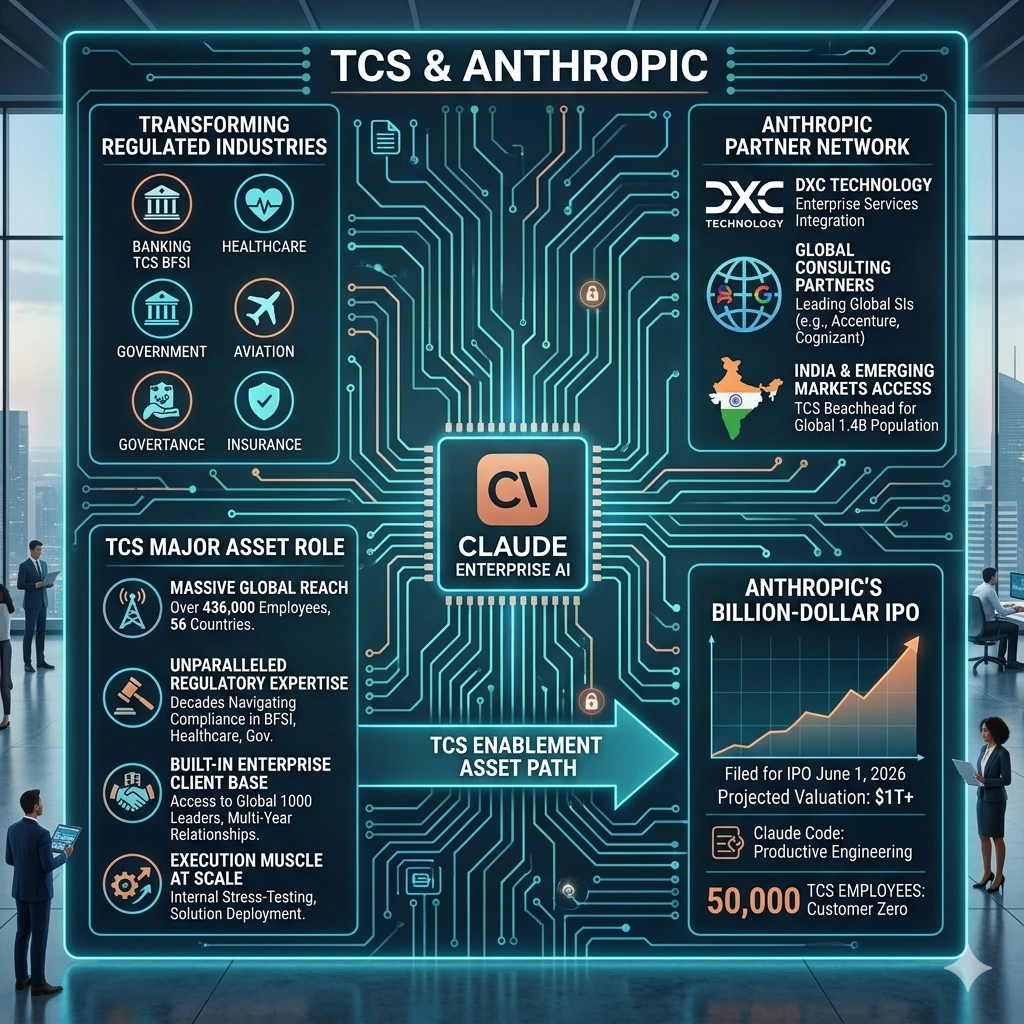
The Partnership: What TCS and Anthropic Are Actually Doing
Beyond the Headlines: The Real Scope
The partnership breaks down into three core components:
1. Internal Deployment Across TCS TCS will deploy Claude to 50,000 of its own employees across 56 countries. This isn't merely internal IT procurement—it's using TCS itself as "customer zero," stress-testing Claude at scale within a regulated environment where errors have real consequences. TCS employees in engineering, finance, legal, marketing, and sales teams will use Claude daily, helping identify gaps, use cases, and optimization opportunities before the company sells solutions to external clients.
2. Dedicated Practice Development TCS is building a dedicated practice combining consultants, engineers, and industry specialists specifically focused on designing and implementing Claude-powered systems. This group will develop industry-specific solutions such as:
- Claims processing automation for insurance companies
- Lending advisory systems for banks
- Regulatory compliance tools for financial services firms
- Healthcare workflow optimization for hospital networks and healthcare systems
- Government service optimization for public sector agencies
3. Claude Partner Network Membership TCS formally joins Anthropic's Claude Partner Network, a network of consulting and services firms that bring Claude to enterprise clients. This positioning gives TCS preferential access to Anthropic's roadmap, early access to new capabilities, and integrated go-to-market support.
Real-World Use Cases Already Underway
The partnership isn't aspirational—concrete projects are already in development:
Diligenta (UK Life & Pensions): TCS's UK-based life and pensions business will use Claude to enhance customer experience for over 22 million policyholders. For an insurance company managing pensions and life insurance policies, Claude can help with policy inquiries, claims processing support, and customer service automation while maintaining strict regulatory compliance.
Banking & Financial Services Teams: TCS's banking divisions are already using Claude Code (Anthropic's specialized coding assistant) to boost productivity in software engineering and IT operations. Financial services are among the most heavily regulated industries globally, so any wins here have outsized demonstration value for regulated industry adoption.
TCS iON: This subsidiary, which conducts 75+ million assessments annually across 1,500 cities in India, will deliver Claude training and certification programs. This extends Claude adoption not just through TCS's direct client base, but through educational and certification channels reaching hundreds of thousands of professionals.
Why This Partnership Matters for Regulated Industries
The AI Adoption Bottleneck
Here's a critical insight that most observers miss: most AI initiatives in regulated industries never make it past the pilot stage. According to research cited by the companies, more than half of organizations cite privacy and security as top challenges for generative AI adoption. For industries like banking, healthcare, insurance, and government—where regulatory requirements are strict, audit trails must be comprehensive, and errors can result in financial or legal liability—the barriers to AI production deployment are extraordinarily high.
The typical scenario plays out like this:
- An organization hears about ChatGPT or other AI tools
- A team gets budget for a pilot project
- The pilot works surprisingly well in a controlled environment
- The team attempts to move to production
- Compliance and risk teams ask questions the team can't answer: How do we audit decisions made by the model? How do we ensure the model isn't using sensitive data inappropriately? How do we prove compliance to regulators? What happens if the model makes a harmful mistake?
- The pilot gets stuck, funding dries up, and the organization shelves the project
This is the bottleneck Claude and TCS are directly addressing.
Why Claude Is Purpose-Built for This
Claude's architecture includes several features specifically designed for regulated environments:
Constitutional AI: Rather than training the model solely on human feedback (the approach used by most competitors), Anthropic trained Claude against a written constitution—a set of principles governing appropriate behavior. This makes Claude's reasoning more transparent, predictable, and auditable.
Compliance API: Claude Enterprise includes programmatic compliance access, enabling continuous monitoring, automated policy enforcement, and real-time integration with compliance dashboards. This transforms compliance from a manual, periodic review process into an automated, continuous practice.
Long Context Windows: Claude Sonnet 4.5 and Opus 4.7 support 1 million token context windows (roughly 750,000 words or 500+ pages). This means lawyers can analyze entire contracts in a single request, auditors can process comprehensive documentation, and compliance teams can maintain full context across complex documents without information loss.
Auditability & Explainability: Every Claude interaction can be logged, reviewed, and explained—critical for regulated industries where agencies like the FDA, OCC, or FCA demand transparency into decision-making processes.
Competitors like OpenAI's GPT or Google's Gemini may be powerful general-purpose models, but they weren't architected for the specific governance and compliance requirements of regulated industries. Claude was.
The Scale and Complexity: Understanding the Deal's True Magnitude
Why This Matters Far More Than It Appears
To truly grasp why this partnership is significant, consider what TCS brings to the table:
Global Regulatory Expertise: TCS has spent decades navigating the compliance requirements of every major regulated market. The company understands financial services regulations in the US (OCC, FDIC guidelines), Europe (GDPR, MiFID II), Asia (ASSOCHAM regulations), and beyond. It understands healthcare regulations from HIPAA in the US to GDPR in Europe. This institutional knowledge is invaluable when implementing AI in highly regulated domains.
Existing Client Relationships: TCS already works with most of the world's largest banks, insurance companies, and government agencies. When TCS sells a Claude-powered solution, it's not knocking on a cold door—it's offering a new tool to a client relationship spanning decades. This removes the sales friction that typically slows enterprise software adoption.
Execution Capability: TCS has the operational muscle to implement enterprise solutions at scale. We're not talking about consulting recommendations—we're talking about actual implementation across hundreds of clients simultaneously.
India as Strategic Anchor: TCS is headquartered in India and has deep roots in the Indian market. Anthropic CEO Dario Amodei explicitly noted that "this partnership deepens our commitment to India, our second-largest market." India represents 1.4 billion people, a rapidly developing financial services sector, government digitalization initiatives, and healthcare modernization—all areas where AI will play critical roles. TCS's presence provides Anthropic with a beachhead in what may become one of the world's largest AI markets.
The Conglomerate Advantage
Remember that TCS is part of the Tata Group. This creates secondary opportunities:
- Cross-divisional opportunities: The Tata Group's diverse portfolio means TCS can deploy Claude solutions not just to external clients, but across group companies. Indian Hotels (Taj Hotels parent company) could use Claude for hospitality optimization. Tata Steel could use Claude for manufacturing optimization. These internal opportunities generate case studies and references for external sales.
- Emerging market infrastructure: The Tata Group has extensive operations across Asia, Africa, and the Middle East. This provides TCS with distribution channels and market access far beyond typical IT consulting firms.
Anthropic's IPO and Why This Partnership is Perfect Timing
The IPO Context
Let's talk about what happens next. Anthropic filed for IPO in early June 2026, and the company is targeting a potential public listing as early as October 2026. At a projected $1 trillion valuation, this would be one of the largest IPOs ever and certainly the largest for a frontier AI company.
For institutional investors evaluating Anthropic, the critical questions are:
- Can Claude actually generate sustainable revenue? Not just a few customers, but enterprise-scale, multi-year, high-value contracts?
- Is there a sustainable business model beyond venture funding? Or is this another venture-backed startup that burns money?
- Can Claude compete in real-world, production environments? Or only in controlled demos?
- Is Claude a general-purpose tool, or does it have specific competitive advantages?
The TCS partnership provides answers to all of these questions:
Why This Partnership Changes the IPO Narrative
Proof of Enterprise Scale: TCS deploying Claude to 50,000 employees across 56 countries proves Claude works at genuine enterprise scale, not just in controlled environments. These are critical business systems where errors have financial consequences.
Regulated Industry Credibility: Regulated industries represent enormous markets—banking, insurance, healthcare, government. If Anthropic can demonstrate that Claude solves critical problems in these regulated domains (where competitors have struggled), it opens up a multi-hundred-billion-dollar total addressable market (TAM). This matters tremendously for a company being valued at $1 trillion.
Durable Competitive Advantage: Many observers question whether Claude's perceived safety advantages are sustainable. The TCS partnership demonstrates that Claude's architecture (constitutional AI, auditability, compliance features) creates genuine differentiation in regulated industries where these features aren't nice-to-haves but legal requirements.
Revenue Visibility: TCS disclosed an AI business pipeline exceeding $1.5 billion. A significant portion of these projects will likely use Claude. This gives institutional investors confidence that revenue isn't theoretical—it's already in the pipeline with one of the world's largest IT services companies.
Global Market Access: Through TCS's global footprint, Anthropic gains distribution channels across 56 countries. Rather than Anthropic building its own enterprise sales organization globally (which would take years), it's leveraging TCS's existing infrastructure.
What This Means for Anthropic's Valuation
At a $1 trillion valuation, Anthropic is being valued on the assumption that frontier AI will become the dominant technology platform of the next decade. The TCS partnership validates this thesis by demonstrating that Claude can integrate into mission-critical enterprise systems where failure isn't an option.
For comparison context:
- Microsoft at similar ARR (~$26 billion) commands a $2.5 trillion market cap, but from a mature, established position
- OpenAI is competing for similar enterprise customers but faces regulatory uncertainty and questions about Claude's competitive positioning in regulated sectors
- Google's Gemini offers scale but lacks the specific architectural advantages for compliance-heavy use cases
The TCS partnership effectively answers the critical question: "Is Claude a general-purpose model, or does it have specific strengths that create durable competitive advantages?" The answer, for regulated industries at least, is clearly the latter.
The Broader Significance: Regulated AI Adoption Entering the Mainstream
Moving Beyond Pilots
For years, AI adoption in regulated industries has been characterized by endless pilots. Companies conduct proof-of-concepts that technically work but never move to production because the governance overhead and regulatory uncertainty create barriers to scaling.
The TCS-Anthropic partnership signals a fundamental shift. Rather than asking "can we use AI?" regulated industry clients are now asking "how quickly can we deploy?" This changes the entire economic picture.
Claims processing in insurance can now be automated with Claude-powered workflows that maintain full auditability for regulators. Lending advisory in banking can be dramatically accelerated while maintaining compliance with Fair Lending regulations. Compliance monitoring in financial services can shift from periodic, manual reviews to continuous, automated processes.
Each of these represents hundreds of millions or billions in value within regulated industries globally.
The Competitive Implications
This partnership creates real competitive pressure for other frontier AI companies:
OpenAI must now rapidly establish partnerships with enterprise consulting firms to match TCS's reach. OpenAI has strong relationships with Microsoft, but that's a different channel.
Google's Gemini must demonstrate specific competitive advantages in regulated industries. Generalist AI capabilities alone won't differentiate against Claude's compliance-specific architecture.
Regional players in Asia, Europe, and other regions must compete with TCS's global delivery model and regulatory expertise.
The partnership fundamentally reshapes the competitive landscape for enterprise AI.
Looking Forward: What's Next
Near-Term Developments
Over the next 12 months, expect:
- Claude deployment across 50,000 TCS employees and integration into TCS's internal systems
- Launch of industry-specific Claude solutions (claims processing, lending advisory, compliance tools)
- Early customer wins from TCS's existing client base
- Anthropic's IPO, likely valuing the company at $1 trillion+
- Additional partnership announcements from Anthropic with other major consulting/systems integration firms (DXC Technology has already announced a similar alliance)
Longer-Term Implications
Over the next 3-5 years, we're likely to see:
- Widespread adoption of Claude in regulated industries, driven by TCS's implementation services
- Thousands of enterprise deployments generating measurable ROI
- A shift from AI pilots to production AI systems in banking, healthcare, government, and insurance
- Anthropic becoming the de facto standard for compliance-intensive enterprise AI
- The Tata Group potentially benefiting tremendously from Claude's success, as the group's other divisions (hotels, steel, energy) potentially adopt Claude for their own operations
Conclusion: A Watershed Moment for Enterprise AI
The TCS-Anthropic partnership isn't just a technology announcement. It represents a watershed moment in enterprise AI adoption, particularly in regulated industries where AI adoption has been constrained by governance and compliance challenges.
For Anthropic, the partnership provides exactly what a $1 trillion-valued company needs to justify that valuation: proof that Claude can generate sustainable, enterprise-scale revenue in the most demanding and highest-value market segments. It demonstrates that Claude's specific architectural advantages in compliance, auditability, and safety aren't marketing narratives—they're genuine competitive advantages that create measurable business value.
For regulated industries globally, the partnership signals that the experimentation phase is over. AI adoption is now moving into the production phase, driven by organizations that have the regulatory expertise and implementation capability to navigate the governance requirements.
For TCS and the Tata Group, the partnership provides an opportunity to lead in the AI-driven transformation of enterprise and regulated industries at a time when AI adoption is transitioning from exploratory initiatives to core business transformation.
As Anthropic approaches its IPO, this partnership will likely be cited repeatedly by institutional investors as evidence that frontier AI companies can build genuine, defensible competitive advantages in specific market segments. That alone makes this partnership one of the most significant enterprise AI announcements of 2026.
Sources and Citations for "TCS and Anthropic Partner to Transform Regulated Industries" Blog Post
Primary Sources
Official Partnership Announcement
Anthropic Official Announcement (June 12, 2026)
- URL: https://www.anthropic.com/news/tcs-anthropic-partnership
- Source: Anthropic Press Release
- Description: Official announcement of TCS-Anthropic partnership with details on deployment scope, use cases, and strategic focus
Company Information
TCS (Tata Consultancy Services)
TCS Official Business Overview
- URL: https://www.tata.com/business/tcs
- Source: Tata Group Official Website
- Information: TCS founding date (1968), employee count (436,000+), global presence (56 countries, 194 service centers), FY2026 revenue (₹267,021 crore), AI business pipeline ($1.5B+)
TCS Business Segments & Services Profile
- URL: https://www.bccresearch.com/company-index/profile/tata-consultancy-services-ltd
- Source: BCC Research
- Information: Business segments (BFSI, Manufacturing, Healthcare, Life Sciences, Telecom, Media & Tech)
TCS Company Overview
- URL: https://www.zoominfo.com/c/tata-consultancy-services-ltd/141738051
- Source: ZoomInfo
- Information: Company founding, service portfolio, global footprint, operational scale
TCS Consulting Services Details
- URL: https://managementconsulted.com/consulting-firm/tata-consultancy-services/
- Source: Management Consulted
- Information: TCS service lines, industry expertise, software products (TCS BaNCS, TCS MasterCraft)
Tata Group Context
Taj Hotels Background
- URL: https://en.wikipedia.org/wiki/Taj_Hotels
- Source: Wikipedia
- Information: Taj Hotels parent company (Indian Hotels Company Limited), founding (1902), 200+ properties, part of Tata Group conglomerate
Anthropic
Anthropic IPO Details and Valuation
- URL: https://www.ig.com/uk/trading-strategies/anthropic-how-to-buy-shares-260612
- Source: IG Markets (June 2026)
- Information: IPO filing date (June 1, 2026), expected listing date (October 2026), projected $1T+ valuation, Series H funding ($65B at ~$965B valuation)
Anthropic IPO and Valuation Analysis
- URL: https://www.heygotrade.com/en/blog/anthropic-ipo-2026/
- Source: Hey Go Trade
- Information: Confidential S-1 filing, $965B valuation, expected $1T+ public debut, annualized revenue growth trajectory
Anthropic IPO Preparation Coverage
- URL: https://www.marketscreener.com/news/anthropic-plans-an-ipo-as-early-as-2026-ft-reports-ce7d51d9d08cf326
- Source: MarketScreener (citing Financial Times)
- Information: Wilson Sonsini law firm engagement, investment bank discussions, 300,000+ business customers (up from <1,000 two years prior), $26B annualized revenue projection
Anthropic IPO and Business Growth
- URL: https://www.mexc.com/news/219018
- Source: MEXC (Crypto News)
- Information: IPO preparations, business customer growth, revenue acceleration
Partnership Analysis & Industry Context
TCS-Anthropic Partnership: Global Premier Status
- URL: https://tradebrains.in/tcs-secures-global-premier-status-with-anthropic-to-scale-claude-ai-across-50000-employees/
- Source: Trade Brains
- Information: Global Premier Partner designation, 50,000 employee deployment, $1.5B+ AI business pipeline, regulated industries focus
TCS-Anthropic Partnership: Regulated AI Adoption
- URL: https://futurumgroup.com/insights/will-tcs-and-anthropics-claude-partnership-set-a-new-standard-for-regulated-ai/
- Source: Futurum Group Analysis
- Information: Regulatory compliance challenges, 53% of organizations cite privacy/security as top GenAI adoption challenge, partnership significance for regulated sectors
Claude for Financial Services
- URL: https://www.anthropic.com/news/claude-for-financial-services
- Source: Anthropic Official Page
- Information: Claude capabilities for regulated industries, use cases in financial services, banking, and healthcare
TCS Partners with Anthropic for Regulated Industries
- URL: https://www.startuphub.ai/ai-news/artificial-intelligence/2026/tcs-taps-anthropic-s-claude-for-regulated-industries
- Source: StartupHub.ai
- Information: Industry-specific Claude solutions, use cases by sector, partnership scope
TCS and Anthropic Partnership Overview
- URL: https://opentools.ai/news/tcs-anthropic-claude-regulated-industries-partnership-2026
- Source: OpenTools
- Information: "Customer zero" approach, existing product development (Diligenta, banking teams, Claude Code for engineering), regulatory requirements and compliance
TCS Partners With Anthropic: Banking, Healthcare, Regulated Industries
- URL: https://www.businesstoday.in/technology/artificial-intelligence/story/tcs-partners-with-anthropic-to-train-50000-employees-on-claude-launch-dedicated-ai-business-unit-536237-2026-06-11
- Source: Business Today
- Information: TCS training initiatives, dedicated AI business unit, regulated industry focus, governance and compliance emphasis
Claude Technical Architecture & Compliance Features
Why Use Claude AI 2026: Compliance and Regulated Industry Capabilities
- URL: https://orbilontech.com/why-use-claude-ai-2026/
- Source: Orbilon Tech
- Information: Constitutional AI approach, Compliance API, long context windows (1M tokens), auditability features, regulated industry requirements
Competitive Context
DXC Alliance with Anthropic
- URL: https://www.anthropic.com/news/dxc-anthropic-alliance
- Source: Anthropic Official Announcement
- Information: Parallel enterprise consulting partnership with DXC Technology (115,000 employees, 70 countries), DXC OASIS platform, "customer zero" approach