With global social media ad spend reaching $247.3 billion in 2025, the pressure to prove performance is at an all-time high. Many marketing teams currently struggle with Meta's $14.19 average CPM and a 20.1% cost increase since last year. You likely feel the frustration of staring at high engagement rates while your stakeholders demand a direct link to revenue. It's exhausting to deal with conflicting platform data and the soul-crushing task of manual data entry every single month.
Learning how to measure social media roi shouldn't be a workflow bottleneck that slows your growth. We'll show you the exact framework to calculate and prove your financial impact without the typical data headache. This guide provides a repeatable formula to turn metrics like the 41% ROI seen in short-form video into clear, actionable business results. You'll gain the confidence to request larger budgets using a simplified reporting process that makes your social media presence a visible driver of profit.
Key Takeaways
- Shift from empty vanity metrics to business-critical data that quantifies the total value of your social media presence.
- Master a streamlined four-step framework to finally understand how to measure social media roi without the manual data entry headache.
- Learn to balance direct revenue tracking with long-term brand equity for a more accurate and sophisticated reporting process.
- Identify hidden costs like management labor to ensure your budget requests are backed by transparent, reliable data.
- Leverage next-generation technology to visualize campaign timing against financial results for a truly effortless management experience.
What is Social Media ROI and Why Does it Matter in 2026?
Social media ROI is the total value created by every action your brand takes across digital channels. It's a specific application of Return on Marketing Investment, tailored to the unique dynamics of social platforms. In 2026, this measurement is more than a luxury; it's a survival requirement. With global social ad spend reaching $247.3 billion in 2025, the days of "posting and praying" are over. You need to know exactly where your dollars go and what they bring back. Understanding how to measure social media roi allows you to justify your budget and scale what works.
The industry has shifted away from vanity metrics. Likes and shares are now secondary to business-critical data like Customer Lifetime Value (CLV) and multi-touch attribution. Platform fragmentation makes this harder than ever. As of February 2026, LinkedIn commands a premium CPC of $2 to $5, while TikTok costs have risen to $3.00 per click for competitive niches. We believe this complexity shouldn't cause stress. Our perspective is that ROI tracking should be Simplified Like Never Before. It's about providing relief through clarity, turning a "data headache" into a strategic advantage.
The ROI Formula Every Marketer Needs
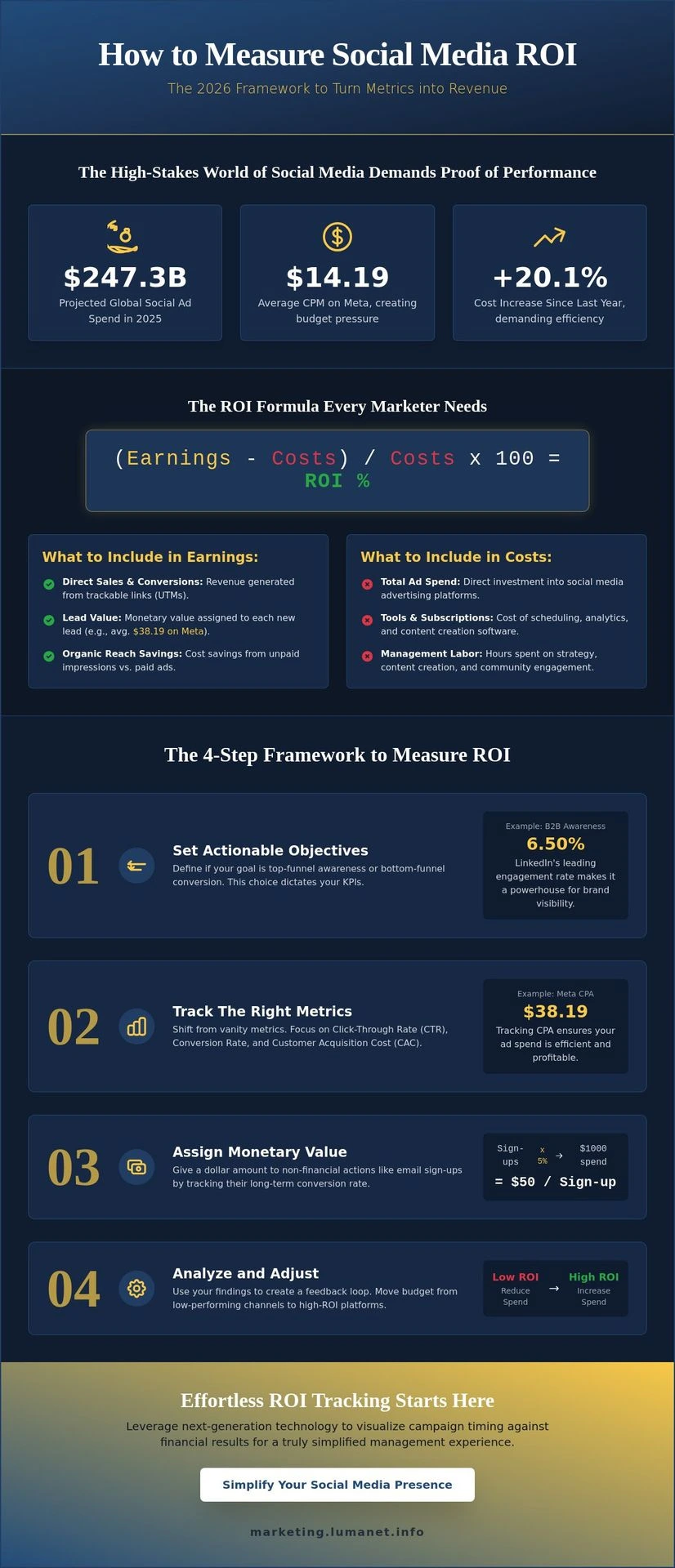
Calculating your return doesn't require a degree in data science. Use the standard formula: (Earnings - Costs) / Costs x 100. To get an accurate result, you must be honest about both sides of the equation. Earnings aren't just direct checkout sales. They include lead value, which averaged $38.19 on Meta as of April 2026, and the savings you gain from organic reach. On the cost side, include your ad spend, platform subscriptions, and the labor hours spent on strategy and engagement. This transparent view ensures your how to measure social media roi efforts are grounded in reality.
The Cost of "Dark Social" and Invisible Returns
Not every conversion happens through a trackable link. "Dark social" refers to private shares in messaging apps or word-of-mouth recommendations that pixels can't see. While 100% data accuracy is a myth in 2026, aiming for "trend accuracy" is the professional standard. You're looking for consistent growth patterns rather than perfect individual data points. This approach reduces the friction of reporting and builds trust with stakeholders. Social Media ROI is a measure of efficiency and growth.
The 4-Step Framework to Measure Social Media ROI
Data without a framework is just noise. Measuring your impact shouldn't be a manual data entry nightmare that eats up your Friday afternoons. A structured, repeatable process removes the friction and provides the relief of knowing your strategy actually works. Understanding how to measure social media roi requires a logical sequence of events that connects daily posts to your bottom line.
- Step 1: Set Actionable Objectives. You must decide if a campaign's goal is top-funnel awareness or bottom-funnel conversion. As of February 2026, LinkedIn leads with a 6.50% engagement rate, making it a powerhouse for B2B awareness.
- Step 2: Track the Right Metrics. Focus on Click-Through Rate (CTR), Conversion Rate, and Customer Acquisition Cost (CAC). With Meta's average CPA sitting at $38.19 in April 2026, tracking these specific KPIs tells you if your spend is truly efficient.
- Step 3: Assign Monetary Value. Give a dollar amount to non-financial actions. If 5% of your email sign-ups eventually spend $1,000, then every sign-up is worth $50 to your business.
- Step 4: Analyze and Adjust. Use your findings to move budget from low-performing platforms to high-ROI channels. This feedback loop ensures you aren't wasting resources on "AI slop" that fails to convert.
Mapping Social Goals to Business Outcomes
Every "Follow" or "Like" should eventually lead to a tangible business result. By using historical data, you can calculate the exact worth of a website visit from social channels. A centralized dashboard makes these connections visible, allowing you to see the big picture without clicking through dozens of different platform tabs. It's about achieving a simplified social media presence that works for you while you focus on growth.
Tracking Tools and Attribution Models
In 2026, choosing between First-Touch and Last-Touch attribution is critical for accurate reporting. First-Touch rewards the post that introduced the brand, while Last-Touch credits the final click before the sale. You can measure social media ROI more effectively by using UTM parameters to keep your data clean. These snippets of code ensure you know exactly which post drove which dollar. This provides the "trend accuracy" needed to make confident budget requests to your stakeholders.
Hard ROI vs. Soft ROI: Balancing Revenue and Brand Value
Distinguishing between immediate sales and long-term brand health is the hallmark of a sophisticated marketing strategy. Hard ROI represents the direct, trackable revenue your social campaigns generate. It's the bottom-line number your CFO wants to see. Soft ROI encompasses brand equity, sentiment, and community growth. While harder to quantify, these elements fuel your future sales funnel. Balancing both is essential for a sustainable social media presence that doesn't burn out your audience with constant sales pitches.
The "Efficient Innovator" approach utilizes a 70/30 split. You should allocate 70% of your goals to hard ROI metrics like lead generation and direct sales. The remaining 30% focuses on soft ROI to build trust and authority. This balance ensures you're hitting immediate targets while protecting your brand's future. A real game-changer in 2026 is the ability to preview engagement trends before they become significant costs. By identifying which topics resonate early, you can pivot your strategy without wasting budget on content that misses the mark.
Effective tracking social media ROI requires looking beyond the spreadsheet. You need to understand how your brand is perceived in the digital marketplace. This dual-focus strategy removes the stress of relying solely on one-off viral hits. Instead, it creates a predictable path to growth that stakeholders can respect and support.
Quantifying Brand Awareness and Sentiment
Measuring your competitive standing starts with Share of Voice (SOV). This metric reveals what percentage of the total conversation in your industry is about your brand. Sentiment analysis is equally vital; it protects your long-term value by alerting you to shifts in public perception. Maintaining a consistent professional image ensures your soft ROI remains high. High-quality visuals build a level of trust that generic AI content simply cannot replicate in a crowded 2026 feed. This data-driven approach tells you exactly where you stand compared to your rivals.
Direct Conversion Tracking and Sales Impact
Direct tracking relies on properly configured conversion pixels. These small pieces of code allow for "Simplified" tracking of the entire customer journey from a social post to a final purchase. You should also measure the Customer Lifetime Value (CLV) of those acquired via social. This provides a clearer picture of long-term profitability. LSE Group technology removes the manual entry from this process, automatically syncing data so you can focus on making high-level decisions. Mastering how to measure social media roi means knowing exactly which dollars are working hardest for you.
Common ROI Measurement Pitfalls and How to Avoid Them
Even the most robust frameworks fail if your data is fundamentally flawed. Mistakes in reporting lead to wasted budgets, missed opportunities, and stakeholder distrust. In a 2026 landscape where social media ad costs have risen 18-25% since 2024, you can't afford to base your strategy on inaccurate numbers. Understanding how to measure social media roi effectively means identifying these traps before they drain your resources.
- Over-reliance on Vanity Metrics: A "Like" doesn't pay the bills. If your reporting focuses on follower growth while your sales remain stagnant, you're measuring popularity, not profit.
- Ignoring Labor Costs: Your ROI calculation is incomplete if it doesn't include the hours spent on strategy and engagement. Time is a finite resource; treat it as a line-item expense.
- Failing to Sync Data: Social media doesn't exist in a vacuum. If your social data isn't talking to your CRM, you're missing the middle of the customer journey.
- Manual Data Entry Errors: Human error is the leading cause of "False ROI." A single typo in a spreadsheet can make a failing campaign look like a winner, leading to disastrous budget reallocations.
The Danger of Siloed Data
Integration is the only way to achieve true clarity. Your SMM platform must communicate directly with your other business tools to provide a single source of truth. We call this the "Simplified Like Never Before" approach to data management. By utilizing an automatic sync, you remove the friction of jumping between tabs. This centralized dashboard prevents "forgotten deadlines" and ensures every data point is captured in real-time. It's about building a reliable system that does the heavy lifting for you.
Overcoming the Attribution Gap in 2026
Privacy updates and cookie-less tracking have made direct attribution more challenging. National brands are increasingly shifting toward "Media Mix Modeling" to account for these gaps. You must stay organized when managing multiple social networks simultaneously to ensure your "trend accuracy" remains high. This requires a next-generation solution that prioritizes clean, actionable data over raw volume. Experience the relief of automated reporting by using our SMM platform to streamline your workflow. It's the most efficient way to master how to measure social media roi without the administrative headache.
Effortless ROI Tracking with the LSE SMM Platform
The administrative burden of manual spreadsheets is the biggest obstacle to business growth. While global social ad spend reached $247.3 billion in 2025, most teams still waste dozens of hours every month on repetitive data entry. The LSE SMM Platform is our next-generation solution designed to provide total ROI clarity. It removes the friction of reporting and replaces it with a streamlined, automated experience. Mastering how to measure social media roi shouldn't feel like a second job; it should be the simplest part of your day.
Our Full Calendar Sync is a real game-changer for campaign management. It allows you to visualize exactly when posts went live alongside the resulting spikes in traffic or revenue. This eliminates the guesswork of matching dates to data points. To make your workflow even faster, the "Hover to Preview" feature lets you analyze performance metrics instantly without leaving your main dashboard. These micro-efficiencies are part of our core promise: Simplified Like Never Before. There is no manual entry, no complex setup, and no risk of forgotten deadlines.
Simplified Reporting for Your Monthly Workflow
Reporting should be a moment of relief, not a source of stress. Our platform generates professional, executive-ready reports in seconds rather than hours. This speed allows you to focus on high-level strategy instead of formatting tables. We offer a transparent month-to-month plan with no long-term commitment required. You just pay as you go. A centralized dashboard acts as the foundation of your digital marketing, pulling data from all channels into one clear source of truth. This level of organization builds trust with stakeholders who value their time and your results.
Scaling Your Success: From Starter to Enterprise
Your technology must grow as your business expands. We offer tiered levels from Starter to Enterprise to ensure you always have the right tools for your specific scale. We are a dynamic partner and add monthly new features to keep you ahead of the competition. You can feel confident adopting a cutting-edge solution that is both powerful and easy to master. Streamline your social media ROI with LSE Group today and experience the efficiency of a silent partner doing the heavy lifting in the background. Knowing how to measure social media roi with precision is the ultimate competitive advantage in 2026.
Turn Your Social Data Into Sustainable Growth
You now have the exact framework to transform your social strategy from a confusing cost center into a transparent profit engine. By applying the four-step measurement process and maintaining a 70/30 split between hard revenue and brand equity, you've mastered how to measure social media roi for the 2026 market. You can now sidestep the manual entry errors that lead to wasted budgets and focus on scaling the 41% ROI potential of short-form video identified in Sprout Social's February 2026 report. This clarity is the ultimate relief for any busy professional who values their time.
Our Next-Generation SMM Platform is here to ensure your reporting remains Simplified Like Never Before. We provide a real game-changer with automatic sync to your email client calendars and consistent monthly feature updates that evolve with your business. You don't have to struggle with platform fragmentation or siloed data anymore. It's time to reclaim your Friday afternoons and lead with confidence. Start your effortless social media management journey with LSE Group today. Your path to measurable, scalable success is finally clear.
Frequently Asked Questions
How do you calculate social media ROI for brand awareness?
You calculate brand awareness ROI by assigning a proxy dollar value to metrics like reach and share of voice. Compare your organic reach costs to the $14.19 median CPM on Meta platforms as of April 2026. This shows the ad spend you saved by generating organic awareness. It's a reliable way to quantify the financial impact of non-conversion goals without the data headache.
What are the best tools to measure social media ROI in 2026?
The best tools in 2026 are those that offer a centralized dashboard and automatic data syncing. Solutions like the LSE SMM Platform or premium CRM integrations are essential for high-level accuracy. These tools remove the administrative friction of jumping between LinkedIn and TikTok analytics. They provide a single source of truth for your entire social media presence and overall digital marketing strategy.
Can I track social media ROI without a dedicated platform?
You can track ROI manually by using UTM parameters and custom spreadsheets. However, this method often leads to a significant time drain due to the 18-25% increase in platform fragmentation since 2024. Manual entry is prone to human errors that result in "False ROI" reports. While possible, it's the least efficient way to understand how to measure social media roi for a growing business.
What is a good ROI for a social media marketing campaign?
A good ROI benchmark is a 5:1 ratio, meaning you earn $5 for every $1 spent. In 2025, paid social campaigns averaged a return of $5.28 per dollar spent across all major platforms. Influencer marketing performed even better with a return of $5.78 per dollar. Your specific targets might vary, but these verified 2025 benchmarks provide a solid goal for your 2026 campaigns.
How does the LSE SMM Platform simplify ROI reporting?
The LSE SMM Platform simplifies reporting through its "Simplified Like Never Before" technology. It features an automatic sync to your email client calendar; this acts as a real game-changer for visualizing campaign timing against results. You get professional reports in seconds without the stress of manual entry. It's a next-generation solution that lets you focus on growth rather than tedious data collection.
Is it possible to measure the ROI of organic social media vs paid ads?
You can measure both by using segmented UTM codes for organic posts and paid advertisements. Organic ROI often focuses on long-term brand equity and community growth, like the 6.50% engagement rates seen on LinkedIn in 2025. Paid ROI is typically more direct, focusing on CAC and conversion rates. Comparing these help you balance your budget between immediate sales and long-term brand health.
How often should I report on my social media ROI?
Most professionals report on ROI monthly to align with broader business cycles and financial periods. However, you should monitor your centralized dashboard weekly to catch engagement trends before they become unnecessary costs. Monthly reporting provides the high-level perspective needed for confident budget requests. It ensures your stakeholders see a consistent pattern of growth without getting lost in daily fluctuations.
What happens if my social media ROI is negative?
If your ROI is negative, you must analyze your how to measure social media roi process for hidden costs or platform mismatches. You might be spending too much on high-CPA channels like Meta, which reached $38.19 per acquisition in April 2026. Use this data to pivot your strategy. Reallocate your budget to higher-performing formats like short-form video, which currently delivers the highest ROI at 41%.With global social media ad spend reaching $247.3 billion in 2025, the pressure to prove performance is at an all-time high. Many marketing teams currently struggle with Meta's $14.19 average CPM and a 20.1% cost increase since last year. You likely feel the frustration of staring at high engagement rates while your stakeholders demand a direct link to revenue. It's exhausting to deal with conflicting platform data and the soul-crushing task of manual data entry every single month.
Learning how to measure social media roi shouldn't be a workflow bottleneck that slows your growth. We'll show you the exact framework to calculate and prove your financial impact without the typical data headache. This guide provides a repeatable formula to turn metrics like the 41% ROI seen in short-form video into clear, actionable business results. You'll gain the confidence to request larger budgets using a simplified reporting process that makes your social media presence a visible driver of profit.
Key Takeaways
- Shift from empty vanity metrics to business-critical data that quantifies the total value of your social media presence.
- Master a streamlined four-step framework to finally understand how to measure social media roi without the manual data entry headache.
- Learn to balance direct revenue tracking with long-term brand equity for a more accurate and sophisticated reporting process.
- Identify hidden costs like management labor to ensure your budget requests are backed by transparent, reliable data.
- Leverage next-generation technology to visualize campaign timing against financial results for a truly effortless management experience.
What is Social Media ROI and Why Does it Matter in 2026?
Social media ROI is the total value created by every action your brand takes across digital channels. It's a specific application of Return on Marketing Investment, tailored to the unique dynamics of social platforms. In 2026, this measurement is more than a luxury; it's a survival requirement. With global social ad spend reaching $247.3 billion in 2025, the days of "posting and praying" are over. You need to know exactly where your dollars go and what they bring back. Understanding how to measure social media roi allows you to justify your budget and scale what works.
The industry has shifted away from vanity metrics. Likes and shares are now secondary to business-critical data like Customer Lifetime Value (CLV) and multi-touch attribution. Platform fragmentation makes this harder than ever. As of February 2026, LinkedIn commands a premium CPC of $2 to $5, while TikTok costs have risen to $3.00 per click for competitive niches. We believe this complexity shouldn't cause stress. Our perspective is that ROI tracking should be Simplified Like Never Before. It's about providing relief through clarity, turning a "data headache" into a strategic advantage.
The ROI Formula Every Marketer Needs
Calculating your return doesn't require a degree in data science. Use the standard formula: (Earnings - Costs) / Costs x 100. To get an accurate result, you must be honest about both sides of the equation. Earnings aren't just direct checkout sales. They include lead value, which averaged $38.19 on Meta as of April 2026, and the savings you gain from organic reach. On the cost side, include your ad spend, platform subscriptions, and the labor hours spent on strategy and engagement. This transparent view ensures your how to measure social media roi efforts are grounded in reality.
The Cost of "Dark Social" and Invisible Returns
Not every conversion happens through a trackable link. "Dark social" refers to private shares in messaging apps or word-of-mouth recommendations that pixels can't see. While 100% data accuracy is a myth in 2026, aiming for "trend accuracy" is the professional standard. You're looking for consistent growth patterns rather than perfect individual data points. This approach reduces the friction of reporting and builds trust with stakeholders. Social Media ROI is a measure of efficiency and growth.
The 4-Step Framework to Measure Social Media ROI
Data without a framework is just noise. Measuring your impact shouldn't be a manual data entry nightmare that eats up your Friday afternoons. A structured, repeatable process removes the friction and provides the relief of knowing your strategy actually works. Understanding how to measure social media roi requires a logical sequence of events that connects daily posts to your bottom line.
- Step 1: Set Actionable Objectives. You must decide if a campaign's goal is top-funnel awareness or bottom-funnel conversion. As of February 2026, LinkedIn leads with a 6.50% engagement rate, making it a powerhouse for B2B awareness.
- Step 2: Track the Right Metrics. Focus on Click-Through Rate (CTR), Conversion Rate, and Customer Acquisition Cost (CAC). With Meta's average CPA sitting at $38.19 in April 2026, tracking these specific KPIs tells you if your spend is truly efficient.
- Step 3: Assign Monetary Value. Give a dollar amount to non-financial actions. If 5% of your email sign-ups eventually spend $1,000, then every sign-up is worth $50 to your business.
- Step 4: Analyze and Adjust. Use your findings to move budget from low-performing platforms to high-ROI channels. This feedback loop ensures you aren't wasting resources on "AI slop" that fails to convert.
Mapping Social Goals to Business Outcomes
Every "Follow" or "Like" should eventually lead to a tangible business result. By using historical data, you can calculate the exact worth of a website visit from social channels. A centralized dashboard makes these connections visible, allowing you to see the big picture without clicking through dozens of different platform tabs. It's about achieving a simplified social media presence that works for you while you focus on growth.
Tracking Tools and Attribution Models
In 2026, choosing between First-Touch and Last-Touch attribution is critical for accurate reporting. First-Touch rewards the post that introduced the brand, while Last-Touch credits the final click before the sale. You can measure social media ROI more effectively by using UTM parameters to keep your data clean. These snippets of code ensure you know exactly which post drove which dollar. This provides the "trend accuracy" needed to make confident budget requests to your stakeholders.
Hard ROI vs. Soft ROI: Balancing Revenue and Brand Value
Distinguishing between immediate sales and long-term brand health is the hallmark of a sophisticated marketing strategy. Hard ROI represents the direct, trackable revenue your social campaigns generate. It's the bottom-line number your CFO wants to see. Soft ROI encompasses brand equity, sentiment, and community growth. While harder to quantify, these elements fuel your future sales funnel. Balancing both is essential for a sustainable social media presence that doesn't burn out your audience with constant sales pitches.
The "Efficient Innovator" approach utilizes a 70/30 split. You should allocate 70% of your goals to hard ROI metrics like lead generation and direct sales. The remaining 30% focuses on soft ROI to build trust and authority. This balance ensures you're hitting immediate targets while protecting your brand's future. A real game-changer in 2026 is the ability to preview engagement trends before they become significant costs. By identifying which topics resonate early, you can pivot your strategy without wasting budget on content that misses the mark.
Effective tracking social media ROI requires looking beyond the spreadsheet. You need to understand how your brand is perceived in the digital marketplace. This dual-focus strategy removes the stress of relying solely on one-off viral hits. Instead, it creates a predictable path to growth that stakeholders can respect and support.
Quantifying Brand Awareness and Sentiment
Measuring your competitive standing starts with Share of Voice (SOV). This metric reveals what percentage of the total conversation in your industry is about your brand. Sentiment analysis is equally vital; it protects your long-term value by alerting you to shifts in public perception. Maintaining a consistent professional image ensures your soft ROI remains high. High-quality visuals build a level of trust that generic AI content simply cannot replicate in a crowded 2026 feed. This data-driven approach tells you exactly where you stand compared to your rivals.
Direct Conversion Tracking and Sales Impact
Direct tracking relies on properly configured conversion pixels. These small pieces of code allow for "Simplified" tracking of the entire customer journey from a social post to a final purchase. You should also measure the Customer Lifetime Value (CLV) of those acquired via social. This provides a clearer picture of long-term profitability. LSE Group technology removes the manual entry from this process, automatically syncing data so you can focus on making high-level decisions. Mastering how to measure social media roi means knowing exactly which dollars are working hardest for you.
Common ROI Measurement Pitfalls and How to Avoid Them
Even the most robust frameworks fail if your data is fundamentally flawed. Mistakes in reporting lead to wasted budgets, missed opportunities, and stakeholder distrust. In a 2026 landscape where social media ad costs have risen 18-25% since 2024, you can't afford to base your strategy on inaccurate numbers. Understanding how to measure social media roi effectively means identifying these traps before they drain your resources.
- Over-reliance on Vanity Metrics: A "Like" doesn't pay the bills. If your reporting focuses on follower growth while your sales remain stagnant, you're measuring popularity, not profit.
- Ignoring Labor Costs: Your ROI calculation is incomplete if it doesn't include the hours spent on strategy and engagement. Time is a finite resource; treat it as a line-item expense.
- Failing to Sync Data: Social media doesn't exist in a vacuum. If your social data isn't talking to your CRM, you're missing the middle of the customer journey.
- Manual Data Entry Errors: Human error is the leading cause of "False ROI." A single typo in a spreadsheet can make a failing campaign look like a winner, leading to disastrous budget reallocations.
The Danger of Siloed Data
Integration is the only way to achieve true clarity. Your SMM platform must communicate directly with your other business tools to provide a single source of truth. We call this the "Simplified Like Never Before" approach to data management. By utilizing an automatic sync, you remove the friction of jumping between tabs. This centralized dashboard prevents "forgotten deadlines" and ensures every data point is captured in real-time. It's about building a reliable system that does the heavy lifting for you.
Overcoming the Attribution Gap in 2026
Privacy updates and cookie-less tracking have made direct attribution more challenging. National brands are increasingly shifting toward "Media Mix Modeling" to account for these gaps. You must stay organized when managing multiple social networks simultaneously to ensure your "trend accuracy" remains high. This requires a next-generation solution that prioritizes clean, actionable data over raw volume. Experience the relief of automated reporting by using our SMM platform to streamline your workflow. It's the most efficient way to master how to measure social media roi without the administrative headache.
Effortless ROI Tracking with the LSE SMM Platform
The administrative burden of manual spreadsheets is the biggest obstacle to business growth. While global social ad spend reached $247.3 billion in 2025, most teams still waste dozens of hours every month on repetitive data entry. The LSE SMM Platform is our next-generation solution designed to provide total ROI clarity. It removes the friction of reporting and replaces it with a streamlined, automated experience. Mastering how to measure social media roi shouldn't feel like a second job; it should be the simplest part of your day.
Our Full Calendar Sync is a real game-changer for campaign management. It allows you to visualize exactly when posts went live alongside the resulting spikes in traffic or revenue. This eliminates the guesswork of matching dates to data points. To make your workflow even faster, the "Hover to Preview" feature lets you analyze performance metrics instantly without leaving your main dashboard. These micro-efficiencies are part of our core promise: Simplified Like Never Before. There is no manual entry, no complex setup, and no risk of forgotten deadlines.
Simplified Reporting for Your Monthly Workflow
Reporting should be a moment of relief, not a source of stress. Our platform generates professional, executive-ready reports in seconds rather than hours. This speed allows you to focus on high-level strategy instead of formatting tables. We offer a transparent month-to-month plan with no long-term commitment required. You just pay as you go. A centralized dashboard acts as the foundation of your digital marketing, pulling data from all channels into one clear source of truth. This level of organization builds trust with stakeholders who value their time and your results.
Scaling Your Success: From Starter to Enterprise
Your technology must grow as your business expands. We offer tiered levels from Starter to Enterprise to ensure you always have the right tools for your specific scale. We are a dynamic partner and add monthly new features to keep you ahead of the competition. You can feel confident adopting a cutting-edge solution that is both powerful and easy to master. Streamline your social media ROI with LSE Group today and experience the efficiency of a silent partner doing the heavy lifting in the background. Knowing how to measure social media roi with precision is the ultimate competitive advantage in 2026.
Turn Your Social Data Into Sustainable Growth
You now have the exact framework to transform your social strategy from a confusing cost center into a transparent profit engine. By applying the four-step measurement process and maintaining a 70/30 split between hard revenue and brand equity, you've mastered how to measure social media roi for the 2026 market. You can now sidestep the manual entry errors that lead to wasted budgets and focus on scaling the 41% ROI potential of short-form video identified in Sprout Social's February 2026 report. This clarity is the ultimate relief for any busy professional who values their time.
Our Next-Generation SMM Platform is here to ensure your reporting remains Simplified Like Never Before. We provide a real game-changer with automatic sync to your email client calendars and consistent monthly feature updates that evolve with your business. You don't have to struggle with platform fragmentation or siloed data anymore. It's time to reclaim your Friday afternoons and lead with confidence. Start your effortless social media management journey with LSE Group today. Your path to measurable, scalable success is finally clear.
Frequently Asked Questions
How do you calculate social media ROI for brand awareness?
You calculate brand awareness ROI by assigning a proxy dollar value to metrics like reach and share of voice. Compare your organic reach costs to the $14.19 median CPM on Meta platforms as of April 2026. This shows the ad spend you saved by generating organic awareness. It's a reliable way to quantify the financial impact of non-conversion goals without the data headache.
What are the best tools to measure social media ROI in 2026?
The best tools in 2026 are those that offer a centralized dashboard and automatic data syncing. Solutions like the LSE SMM Platform or premium CRM integrations are essential for high-level accuracy. These tools remove the administrative friction of jumping between LinkedIn and TikTok analytics. They provide a single source of truth for your entire social media presence and overall digital marketing strategy.
Can I track social media ROI without a dedicated platform?
You can track ROI manually by using UTM parameters and custom spreadsheets. However, this method often leads to a significant time drain due to the 18-25% increase in platform fragmentation since 2024. Manual entry is prone to human errors that result in "False ROI" reports. While possible, it's the least efficient way to understand how to measure social media roi for a growing business.
What is a good ROI for a social media marketing campaign?
A good ROI benchmark is a 5:1 ratio, meaning you earn $5 for every $1 spent. In 2025, paid social campaigns averaged a return of $5.28 per dollar spent across all major platforms. Influencer marketing performed even better with a return of $5.78 per dollar. Your specific targets might vary, but these verified 2025 benchmarks provide a solid goal for your 2026 campaigns.
How does the LSE SMM Platform simplify ROI reporting?
The LSE SMM Platform simplifies reporting through its "Simplified Like Never Before" technology. It features an automatic sync to your email client calendar; this acts as a real game-changer for visualizing campaign timing against results. You get professional reports in seconds without the stress of manual entry. It's a next-generation solution that lets you focus on growth rather than tedious data collection.
Is it possible to measure the ROI of organic social media vs paid ads?
You can measure both by using segmented UTM codes for organic posts and paid advertisements. Organic ROI often focuses on long-term brand equity and community growth, like the 6.50% engagement rates seen on LinkedIn in 2025. Paid ROI is typically more direct, focusing on CAC and conversion rates. Comparing these help you balance your budget between immediate sales and long-term brand health.
How often should I report on my social media ROI?
Most professionals report on ROI monthly to align with broader business cycles and financial periods. However, you should monitor your centralized dashboard weekly to catch engagement trends before they become unnecessary costs. Monthly reporting provides the high-level perspective needed for confident budget requests. It ensures your stakeholders see a consistent pattern of growth without getting lost in daily fluctuations.
What happens if my social media ROI is negative?
If your ROI is negative, you must analyze your how to measure social media roi process for hidden costs or platform mismatches. You might be spending too much on high-CPA channels like Meta, which reached $38.19 per acquisition in April 2026. Use this data to pivot your strategy. Reallocate your budget to higher-performing formats like short-form video, which currently delivers the highest ROI at 41%.