
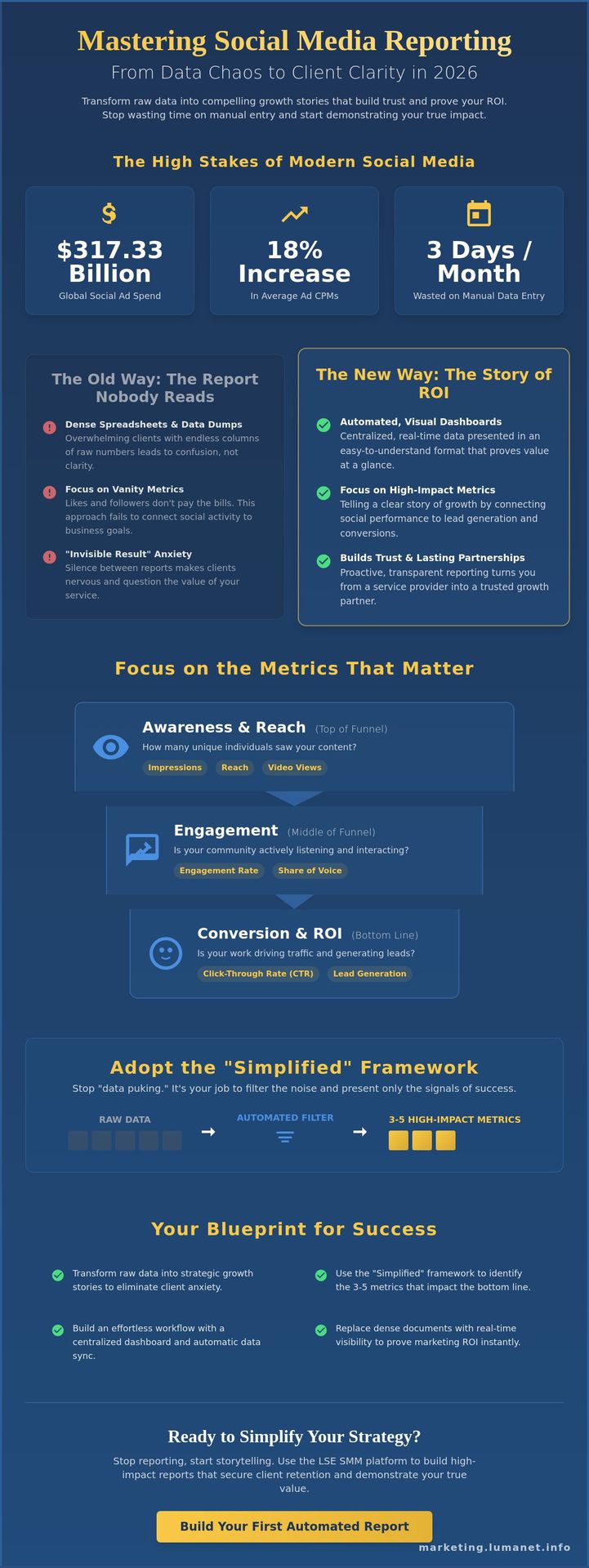
What if the three days you spend every month on manual data entry are actually the reason your clients feel disconnected from your results? In a year where global social ad spend has hit $317.33 billion and average CPMs have jumped 18%, simply sending a spreadsheet isn't enough to prove your worth. You're likely exhausted by the monthly cycle of translating technical jargon into something a business owner understands. Mastering social media reporting for clients shouldn't feel like a second job. It should be the moment you demonstrate your impact and secure long term trust.
We agree that your time is better spent on strategy than on copying numbers from a dashboard. This guide will show you how to build high-impact reports that get read and respected. You'll learn to create an automated workflow that turns raw data into a clear story of ROI, making your process simplified like never before. With 96% of social media professionals now using AI tools in their daily workflow, we'll walk through the exact steps to ensure your value is visible and your client retention stays high throughout 2026.
Key Takeaways
- Transform raw data into strategic growth stories that eliminate client anxiety and build lasting professional trust.
- Use the "Simplified" framework to identify the 3-5 high-impact metrics that directly influence your client’s bottom line.
- Build an effortless workflow for social media reporting for clients by using a centralized dashboard with automatic sync.
- Replace dense, ignored documents with real-time visibility and at-a-glance utility to prove your marketing ROI instantly.
- Adopt a next-generation approach to management that prioritizes micro-efficiencies and removes the friction of manual data entry.
Why Social Media Reporting for Clients is the Secret to Retention
Your clients aren't just buying posts; they're buying progress. In 2026, social media reporting for clients has evolved into the strategic translation of raw data into compelling business growth stories. It's no longer enough to hand over a spreadsheet of likes and comments. You must show how your work impacts the bottom line. This narrative approach turns cold numbers into a roadmap for future success. Social media reporting is a centralized transparency mechanism for digital marketing.
The industry has seen a massive shift away from vanity metrics this year. With global social ad spend reaching $317.33 billion, expectations are higher than ever. Clients are watching their budgets closely, especially as average CPMs have climbed 18% recently. They want to see business-impact metrics like lead generation and conversion rates. When you provide this level of detail, you prove your value as an efficient innovator rather than just another line item on their expense report.
The Psychology of Client Reporting
Clients often feel a deep sense of "invisible result" anxiety. They know they're spending money, but they can't always see the gears turning in the background. High-quality reporting provides instant relief. It replaces that nagging uncertainty with a sense of modern reliability. When you present organized, clear data, you move from being a simple service provider to a trusted growth partner. The cost of poor communication is high. Silence often leads to cancellations because results that aren't reported effectively simply don't exist in the client's mind. They need to feel the momentum you're building every single month.
Proving ROI in a Multi-Channel World
Tracking impact across Facebook, Instagram, and LinkedIn is a complex challenge. Fragmented data makes it difficult to see the big picture without the right tools. This is where social media analytics serves as the backbone of your strategy. By using a centralized SMM platform, you can sync all channels into a single, cohesive view. This setup allows you to align social data directly with the client's specific business goals. It's simplified like never before. You don't have to jump between tabs to find the truth. Instead, you can focus on analyzing the "why" behind the numbers, ensuring your digital marketing strategy stays agile and effective.
Selecting High-Impact Metrics Your Clients Actually Care About
Your clients are busy. They don't have time to sift through forty pages of data to find the one number that matters. The most effective social media reporting for clients utilizes a simplified framework. You should focus on the 3-5 metrics that directly drive their specific business goals. In 2026, the volume of data available is staggering, but more isn't always better. If you provide too much, you risk "data puking" where the client misses the narrative of growth entirely. It's your job to filter the noise and present only the signals of success.
Metrics like total followers have lost their luster. Instead, sophisticated agencies prioritize engagement rate and share of voice. High engagement indicates a community that actually listens. In fact, 76% of consumers feel more loyal to brands that actively reply to comments and DMs. Share of voice measures how much of the online conversation your client owns compared to their competitors. This is vital for national brands fighting for market dominance. For a deeper dive into structuring these insights, this social media reporting guide offers excellent templates for visualizing these high-level shifts.
Awareness and Reach: The Top of the Funnel
Explain the difference between impressions and reach using a simple analogy. Impressions represent the total number of times a post appeared on a screen. Reach tells you how many unique individuals saw it. In 2026, video views have become the primary driver of brand visibility. Short-form video is currently the highest-performing content format, making it the top priority for awareness campaigns. Tracking these metrics across the United States requires a tool that eliminates regional silos so you can see the total national impact clearly and without confusion.
Conversion and ROI: The Bottom Line
This is where you prove your worth as a growth partner. Click-through rates (CTR) show how effectively your content drives traffic to the client's website. Effective social media reporting for clients isn't just about showing what happened; it's about explaining why it matters for their wallet. By January 2026, attributing lead generation to specific social campaigns has become a standard expectation. You need to show exactly which post or ad resulted in a customer inquiry. The LSE SMM Platform allows you to track these bottom-line metrics effortlessly. You can explore our centralized dashboard to see how we simplify the connection between social activity and marketing ROI. This level of clarity removes the friction from your reporting process and builds immediate trust.
Step-by-Step: Building an Effortless Reporting Workflow
Most guides tell you what to include in a report. They often ignore the friction of the actual delivery process. If you're spending hours every month on manual data entry, your agency's profitability is at risk. Building an efficient workflow for social media reporting for clients is about removing that administrative weight. You need a system that works in the background so you can focus on strategy. This process is simplified like never before when you follow a structured, automated path.
- Step 1: Audit objectives. Review your client’s core business goals to set meaningful reporting benchmarks. You can't prove growth if you don't know the starting line.
- Step 2: Centralize your data. Connect all social channels to a centralized dashboard. This ensures an automatic sync of every metric from Facebook to LinkedIn.
- Step 3: Define frequency. Set a recurring schedule. High-spend campaigns might need weekly check-ins; steady-state brand awareness usually thrives on a monthly cadence.
- Step 4: Perform a quick audit. Use "Hover to Preview" features to audit content performance. This allows you to catch anomalies before the report reaches the client.
- Step 5: Automate delivery. Schedule the final report to send automatically. This guarantees no forgotten deadlines and zero manual entry errors.
Automating the Data Collection
Manual entry is the primary enemy of a scalable agency. It's slow; it's prone to human error; it's frustrating. Understanding the technical side of social media analytics ensures your data remains accurate across every API connection. The real game-changer is syncing your report deadlines directly with your email client calendar. This creates a seamless flow between your management tools and your daily schedule. By relying on direct API integrations, you ensure the numbers your client sees are always the ground truth.
Visualizing Success Without the Graphic Designer
You don't need a design degree to create professional visuals. Simplified dashboards turn complex datasets into clean, high-impact charts instantly. Another powerful feature is the full calendar sync. It allows you to show a visual history of past activity alongside future scheduled posts. This transparency builds confidence. To add a personal touch, include a brief, punchy executive summary at the top of every automated report. This explains the "why" behind the numbers in under three sentences. Effective social media reporting for clients should feel like a relief for both you and the person reading it.
Overcoming the "Nobody Reads the Report" Objection
It’s a common agency frustration. You spend hours crafting a detailed PDF, only for it to sit unopened in a client’s inbox. Traditional social media reporting for clients fails because it often lacks at-a-glance utility. With average CPMs rising 18% in early 2026, clients are more anxious about their spend than ever. They don't want a data dump; they want to know if their investment is working. If your reports are too dense, they become a chore rather than a tool. We solve this by prioritizing real-time visibility. This approach keeps your work top-of-mind without requiring the client to dig through complex attachments.
Our "Simplified Like Never Before" approach focuses on the executive summary. This isn't a long-winded essay. It’s a three-sentence highlight of your biggest wins. As of January 2026, social platforms have surpassed traditional search engines for product discovery among major demographics. Your summary should reflect this shift by focusing on how your strategy captures that search intent. When you provide high-impact insights quickly, you respect the client's time and build immediate professional trust.
The Power of the Centralized Dashboard
Giving your clients 24/7 access to their social media presence changes the relationship dynamic. They don't have to wait for the end of the month to see progress. A centralized dashboard provides total transparency into every channel you manage. This reduces the constant stream of "status update" emails and phone calls. It creates a next-generation experience that feels sophisticated and reliable. You’re no longer just sending a file; you’re providing a portal into their brand’s growth. This constant access removes the friction of "invisible results" and proves your value every single day.
Using Calendar Sync as a Reporting Tool
Visual proof is the strongest form of reporting. Seeing a full calendar of published and upcoming posts is the ultimate proof of work. It’s hard for a client to overlook your value when they see a consistent grid of activity. Automatic sync to your client’s email calendar is the real game-changer here. It ensures that your work is visible where they already spend their time. This prevents forgotten deadlines on both sides and keeps everyone aligned on the strategy. The LSE SMM Platform turns your content schedule into a living report that updates in real time. You can get started with our centralized dashboard to provide this level of effortless transparency today. This transition from static PDFs to dynamic visibility is what separates modern growth partners from old-school service providers.
Simplifying Your Strategy with the LSE SMM Platform
The LSE SMM Platform acts as your agency's efficient innovator. We've built a tool that handles the complex background work so you can focus on high-level strategy. Social media reporting for clients shouldn't be a source of stress or a drain on your profitability. By adopting our next-generation technology, you're choosing a partner that prioritizes your time. We offer total flexibility with no long-term commitment required. You just pay month to month. This ensures the platform scales exactly when your business does.
Micro-efficiency wins are at the heart of our design. Features like Hover to Preview allow you to audit content performance in seconds without deep clicking. The automatic sync is the real game-changer for busy teams. It ensures your data is always current across every dashboard. This removes the friction of manual entry and ensures you never send a report with outdated information. LSE Group serves as the silent partner that does the heavy lifting. We allow you to present a polished, professional image to every client without the manual grind.
Next-Generation Features for 2026
The digital landscape moves fast. We add monthly new features to ensure you're always ahead of the curve as social platforms evolve. Whether you're managing three accounts or three hundred, our system supports your growth. You can move from Starter to Enterprise levels without the friction of a new setup or complex data migration. Our simplified pricing model is designed to respect agency margins while providing high-tech authority. This transparency is a core part of our mission to make sophisticated technology feel approachable for every professional.
Getting Started with Effortless Reporting
Transitioning from manual spreadsheets to a centralized platform takes only minutes. You'll feel an immediate sense of relief once your full calendar sync is active. No more checking multiple tabs to verify if a post went live. No more forgotten deadlines. The system manages the administrative load, giving you back hours of productive time every month. It's time to move beyond the manual grind and embrace a workflow that is simplified like never before. You can Experience Social Media Management Simplified Like Never Before and see how a centralized dashboard transforms your social media reporting for clients today.
Take Control of Your Agency's Growth Stories
Stop treating your monthly reports as a chore and start viewing them as your most powerful retention tool. By focusing on the 3-5 metrics that drive the bottom line and providing real-time visibility, you prove your value as a growth partner. As global social commerce reaches $1.09 trillion in 2026, your clients need to see exactly how your strategy captures that market share. Modern social media reporting for clients is about clarity, not volume. It's about showing the path from a social post to a completed purchase.
LSE Group provides the next-generation SMM technology you need to stay ahead. Our platform is simplified like never before, offering automatic sync to email client calendars so you never miss a deadline. There's no manual entry required; our system handles the heavy lifting while you focus on high-level strategy. You can scale from starter to enterprise levels effortlessly while maintaining your agency's professional edge and protecting your margins. It's time to let your results speak for themselves through a dashboard that works as hard as you do.
Start Your Effortless Social Media Reporting with LSE SMM Platform and reclaim your time today. You have the tools to turn complex data into a narrative of success.
Frequently Asked Questions
What is the most important metric in social media reporting for clients?
The most important metric is the one that aligns directly with your client's specific business goals. While engagement shows community health, conversion rates prove your social media reporting for clients delivers real-world value. In 2026, 78% of social commerce purchases happen within the platform. Focus on metrics that show how your strategy turns followers into customers. This approach establishes you as a growth partner rather than a simple service provider.
How often should I send social media reports to my clients?
Send reports once a month for general brand awareness and every week for high-velocity ad campaigns. This cadence matches the decision-making speed of most marketing teams. Monthly reports allow for trend analysis across a 30 day window. Weekly updates catch performance anomalies early; this is vital when average CPMs fluctuate. Consistency builds trust and ensures your work remains top of mind without overwhelming the client's inbox.
How can I automate my social media reporting without losing the personal touch?
Use automated data collection to handle the heavy lifting and add a custom executive summary to provide context. The LSE SMM Platform makes this effortless by syncing raw data instantly into professional visuals. You can then spend your saved time writing three punchy sentences that explain the "why" behind the numbers. This hybrid approach offers the relief of automation while maintaining the human connection that secures long term client loyalty.
What is the difference between a social media report and an analytics dashboard?
A social media report is a structured snapshot of performance over a specific period; an analytics dashboard provides real time, 24/7 visibility. Reports are designed to tell a story of growth and ROI. Dashboards offer a centralized view for daily monitoring. Using both ensures you provide the big picture narrative in monthly meetings and total transparency for clients who want to check their social media presence at any moment.
Can I sync my social media reporting deadlines with my Google or Outlook calendar?
You can absolutely sync your social media reporting for clients with your Google or Outlook calendar. This feature is a real game changer for agency organization. It ensures that report deadlines appear alongside your daily meetings, making it impossible to forget a delivery date. LSE SMM Platform prioritizes this level of administrative ease, allowing you to manage multiple clients with no forgotten deadlines and zero manual entry errors.
Is it better to send PDF reports or give clients dashboard access?
Dashboard access is superior because it provides real time transparency and reduces the friction of status update requests. While PDF reports are useful for archival purposes, they are often too dense and lack at a glance utility. Giving clients access to a centralized dashboard creates a next generation experience. It allows them to hover to preview everything and see their progress instantly, which builds immediate professional trust and modern reliability.
How do I explain a dip in social media performance to a client?
Explain a performance dip by identifying the specific external factor, such as a platform algorithm update or a shift in competitor ad spend. Use data to show that you've identified the cause and immediately present a simplified pivot plan. Transparency is the key to maintaining trust during fluctuations. Clients value an efficient innovator who spots a problem and offers a solution before being asked, turning a challenge into a demonstration of expertise.
What tools are best for managing multiple client social media accounts in 2026?
The best tools in 2026 are centralized SMM platforms that offer full calendar sync and automatic data integration. With 96% of professionals using AI tools, you need a solution that evolves with the landscape. Look for platforms that prioritize micro efficiencies and offer a simplified user experience. This allows your team to handle the heavy lifting in the background while you focus on scaling your agency from starter to enterprise levels without setup friction.